Historic Dunfermline
Malcolm Canmore’s Tower: Dunfermline’s Oldest Royal Story
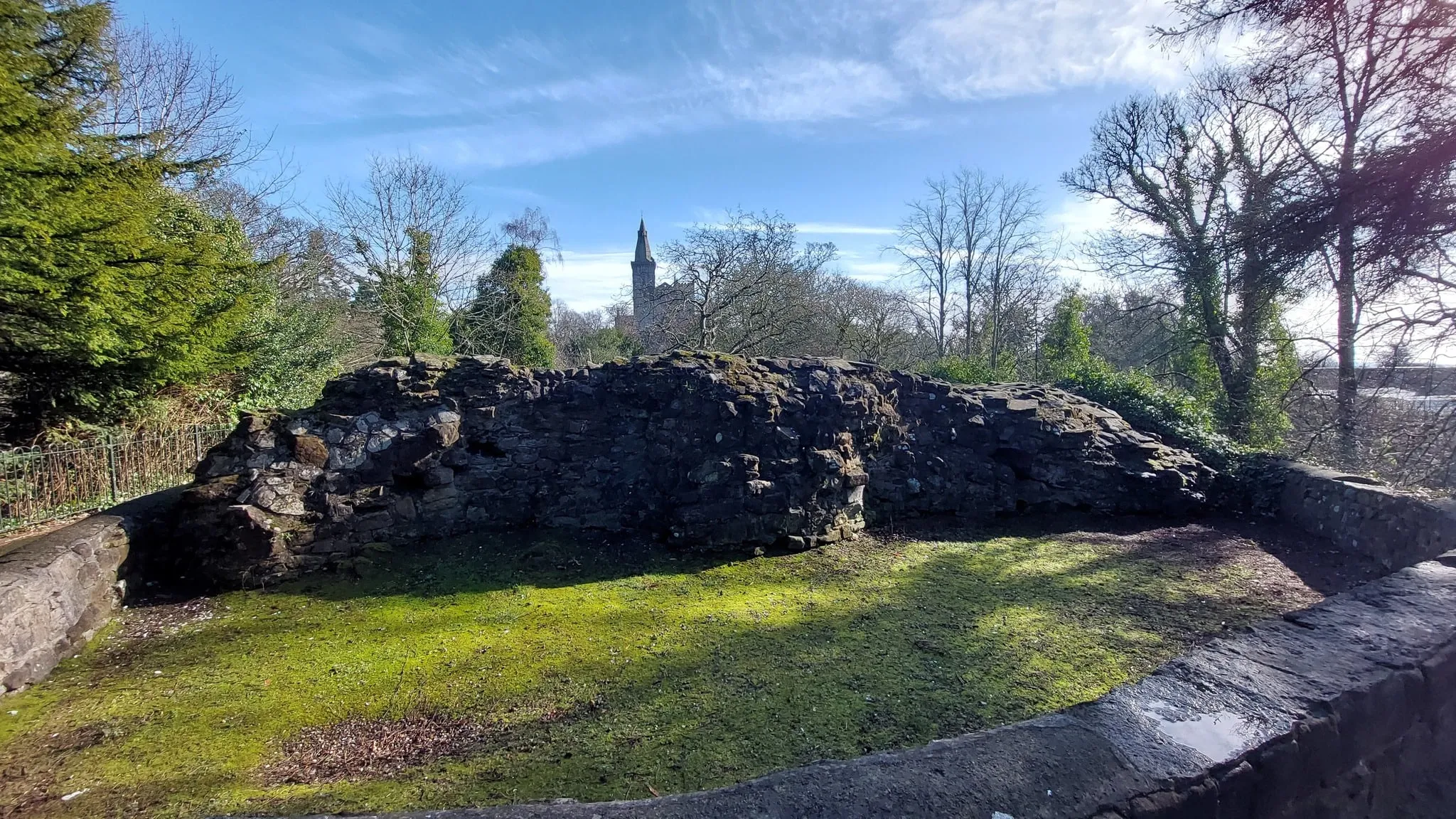
Dunfermline’s Oldest Royal Story. Origins, significance, research. All the facts that are known today about King Malcolm’s Tower.
Malcolm Canmore’s Tower has long been associated with the origins of Dunfermline and remains one of the most symbolic sites in the city’s history. This tower is generally identified as King Malcolm Canmore’s Tower, which many historians believe was once his residence at Dunfermline.
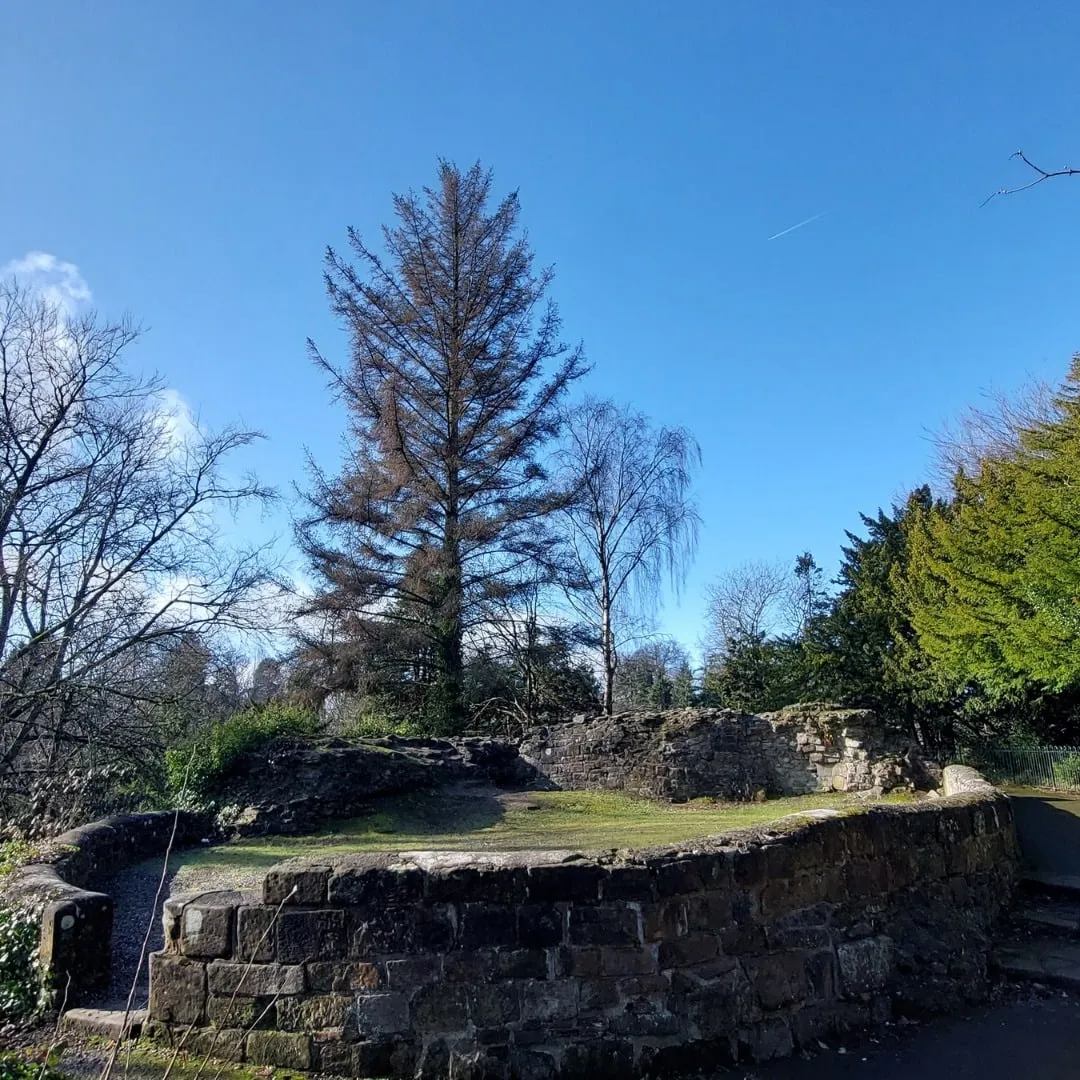
The ruins stand on a rocky hill in Pittencrieff Park, the Glen, about seventy feet (21.3m) above the Tower Burn that curves around its base. The northern side of the hill is steep, rugged and rocky, making it naturally defensive, although the current formation is now mostly man-made following attempts over the last centuries to preserve the rock from collapsing.
Nevertheless, this landscape is closely connected to the origin of the town’s name. “Dunfermline” is commonly translated from Gaelic as “a fort on the hill by the crooked rivulet,” a description that fits the position of the tower remarkably well.
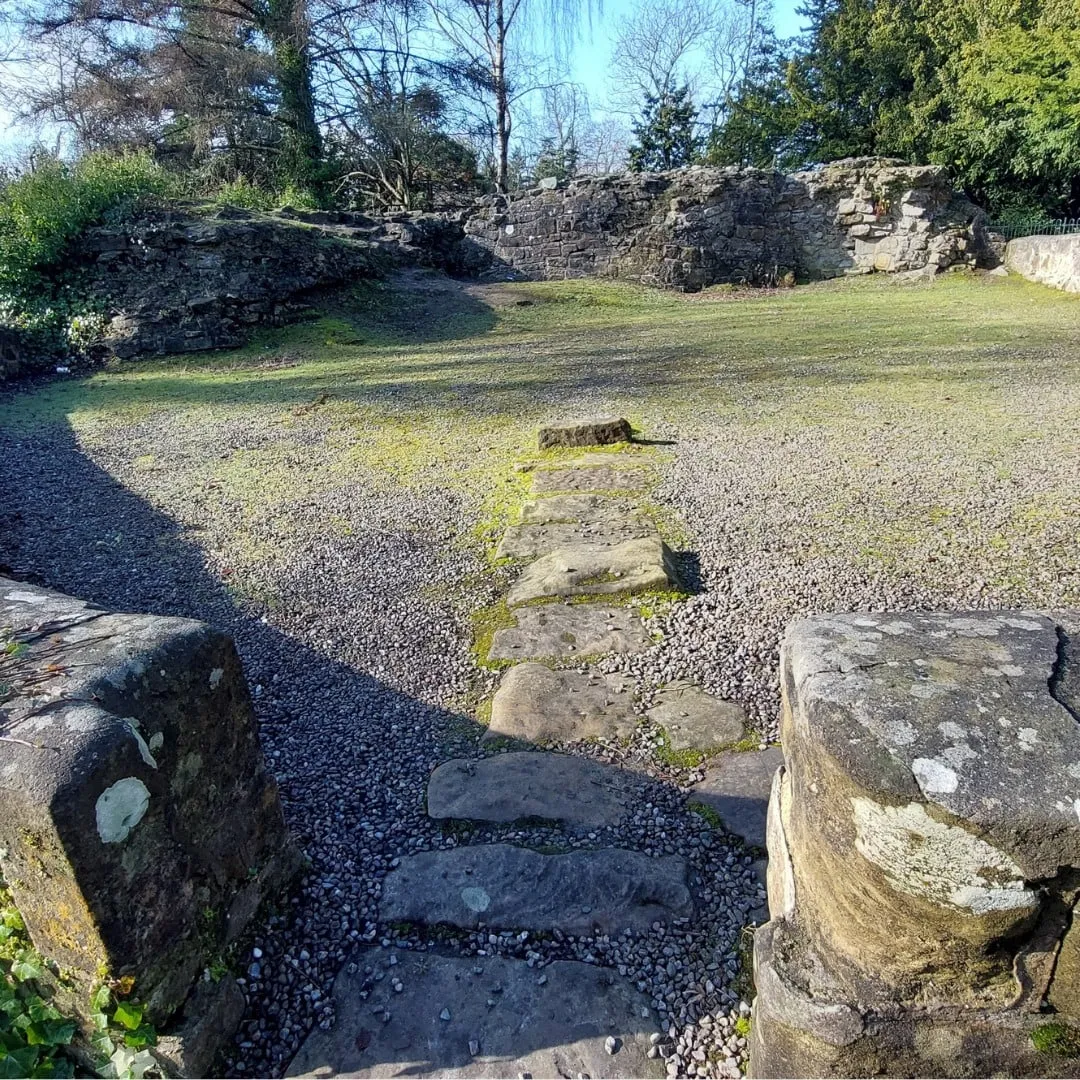
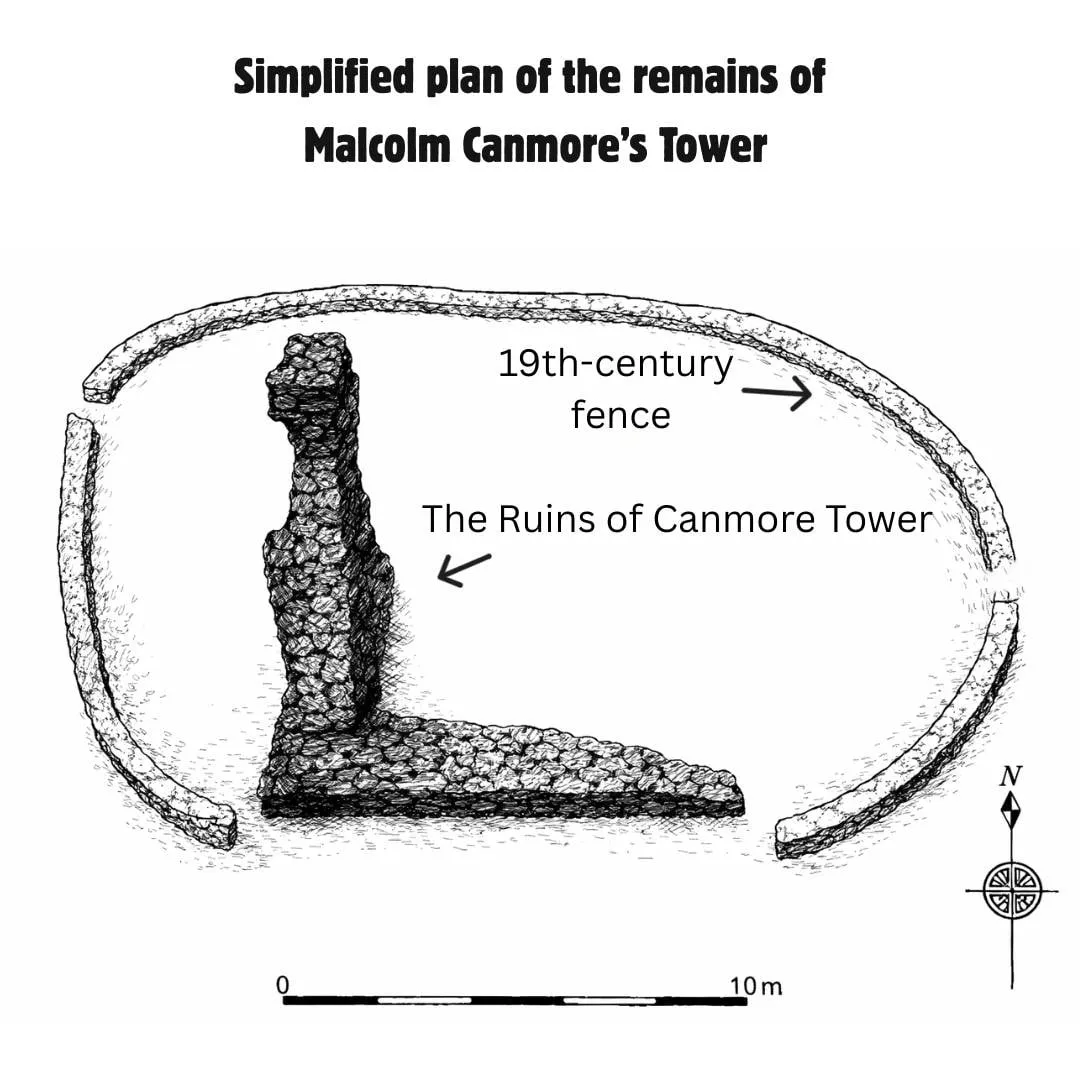
Today, only a small fragment of the structure survives. The remaining ruins consist of the connected angle of the south and west walls. The south wall fragment measures about 31 feet in length (9.4 m) and the west wall about 44 feet (13.4 m). The surviving masonry now stands only about 8 feet (2.4 m) in height. The walls were originally very thick, but the hewn facing stones (the cut stones) have long since been removed. When complete, the base of the tower appears to have measured roughly 50 feet (15.2 m) from north to south and about 60 feet (18.2 m) from east to west, suggesting that the building was almost square in plan.
Despite the strong tradition linking the tower to Malcolm III, historical references to the structure are surprisingly scarce. There is no clear contemporary mention of Dunfermline or the tower until around 1069 or 1070, when Malcolm married Margaret. After that event, neither written history nor later tradition provides detailed descriptions of the building or its surroundings, leaving much of its early history uncertain.
The medieval chronicler John of Fordun gives one of the earliest descriptions of the area. Writing in the 14th century, he described Malcolm’s residence as being strongly fortified by nature, surrounded by dense woods and protected by steep rocks, with a central plain defended by streams and crags. Although Fordun does not explicitly mention a tower, the landscape he describes closely resembles the geography of Tower Hill in Pittencrieff Glen. Fordun also recounts a story in which Malcolm confronted a treacherous baron during a hunting expedition in the nearby forest. This tradition has led some historians to suggest that the earliest structure on the site may have been a hunting lodge rather than a permanent royal residence.
Archaeological evidence also suggests that the tower was not an isolated structure. Before the foundation of the Abbey, there was already a small settlement in the area, including a Culdee church. Early habitation may have been located to the north west of Tower Hill before later expanding and relocating toward the flatter ground around the Abbey. The wider Dunfermline area had been inhabited long before the medieval period. Twentieth century archaeological investigations discovered traces of prehistoric settlement in nearby locations such as Masterton and Pitcorthie, indicating that people had lived in the region since the Neolithic or Bronze Age. The sheltered position of Dunfermline, close to the sea yet inland, surrounded by rivers and rocky terrain, would have made it an attractive and defensible location for early communities. Nevertheless, the Dunfermline we know today is closely tied to the presence of Malcolm and Margaret and the stronghold associated with their name.
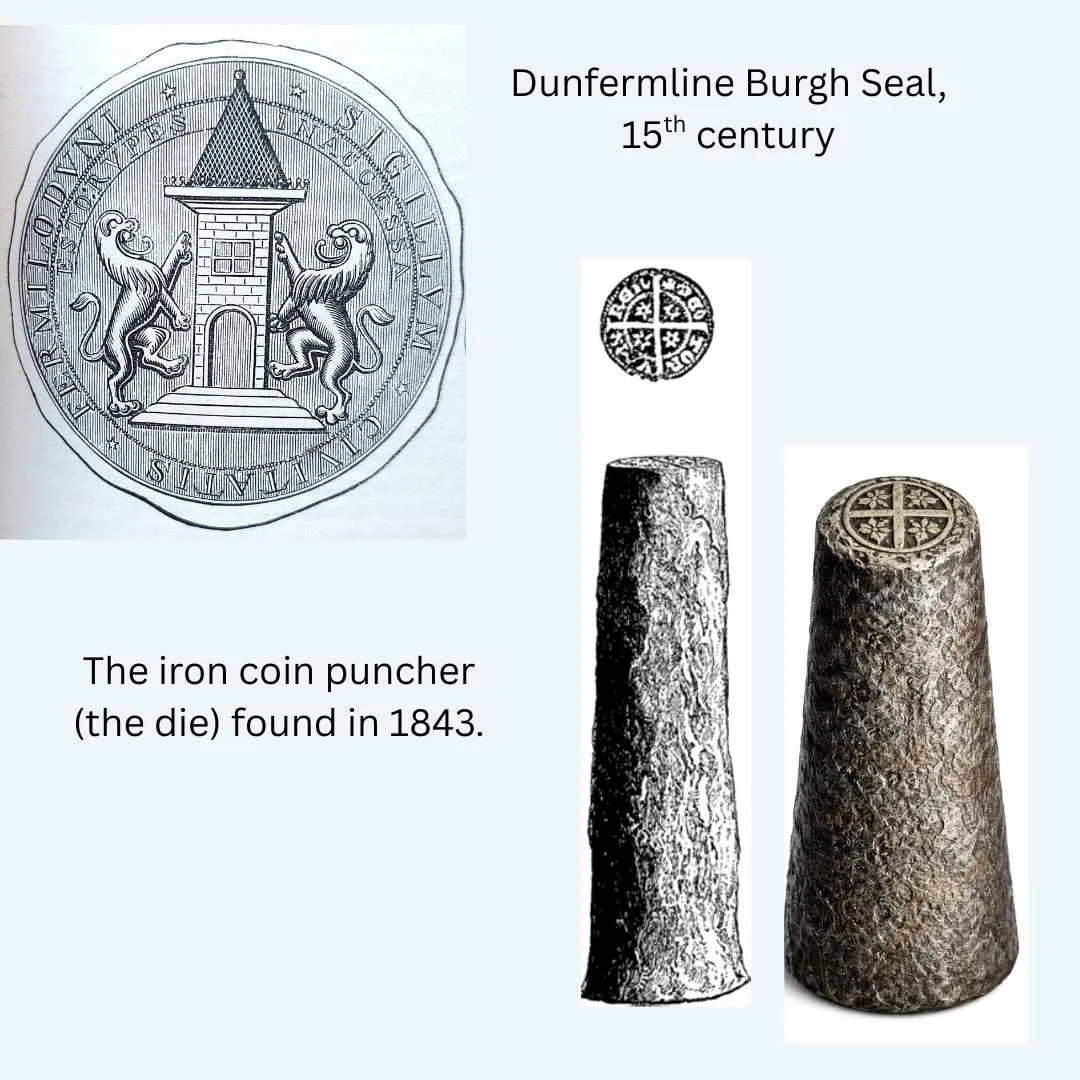
By the late medieval period, the tower had become an important symbol of Dunfermline itself. The earliest surviving burgh seal, dating from around 1500, depicts a tower believed to represent Canmore’s Tower. This symbol later became part of the town’s arms together with the motto “Esto rupes inaccessa,” meaning “Be thou an inaccessible rock,” a phrase that reflects the defensive strength of the rocky site on which the tower stood. It is believed that King Robert the Bruce himself may have been the source of the Dunfermline motto following his victory in the Wars of Independence.
Interest in the ruins increased during the 18th century when antiquarians began to study the site more closely. The ruins on Tower Hill were first clearly recorded in the late 17th century by early writers such as Sir Robert Sibbald and John Slezer. Their accounts helped revive interest in the site and contributed to the growing association between the ruins and Malcolm Canmore. By this time, the tower had already become firmly embedded in the identity of the town through its appearance on seals, heraldry and local tradition.
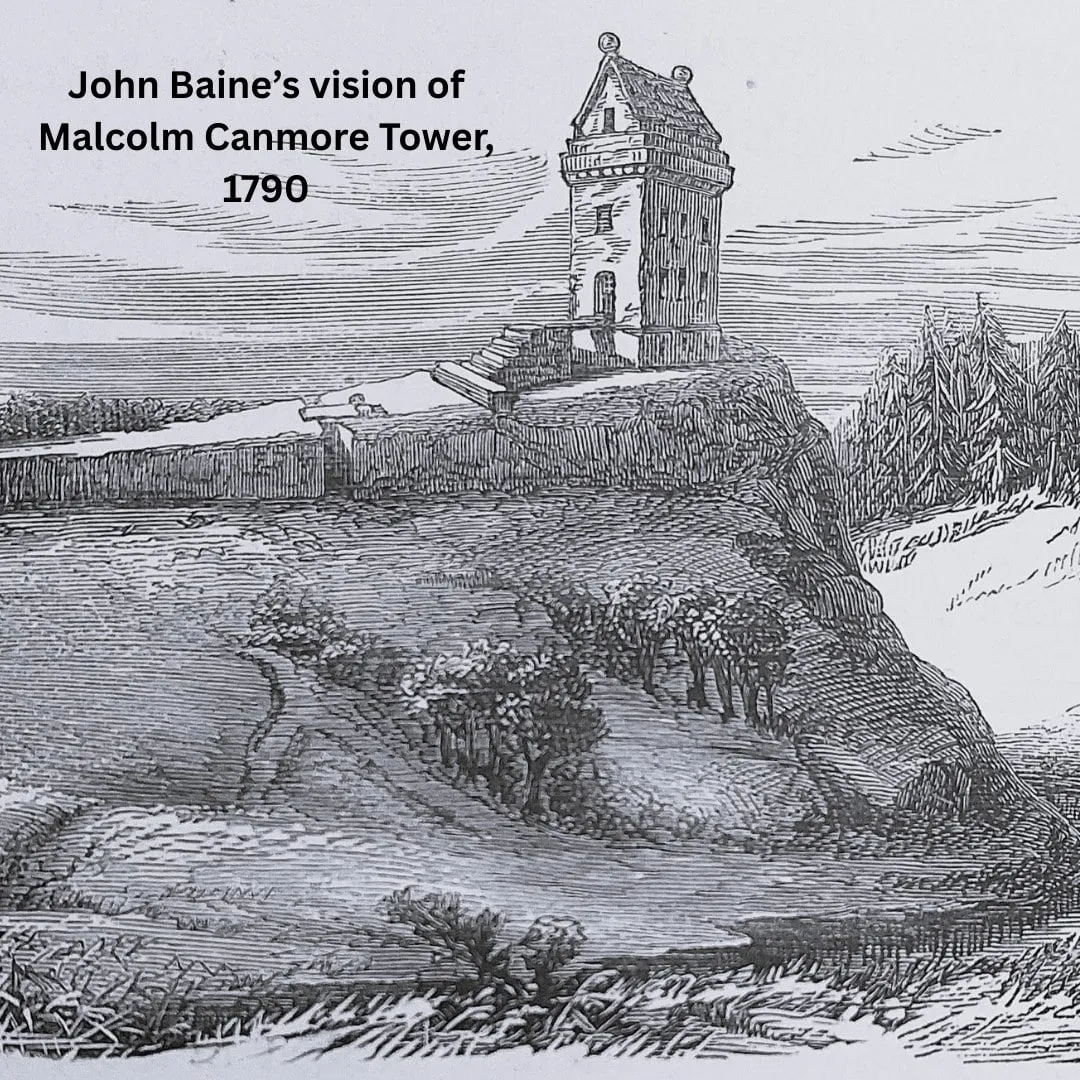
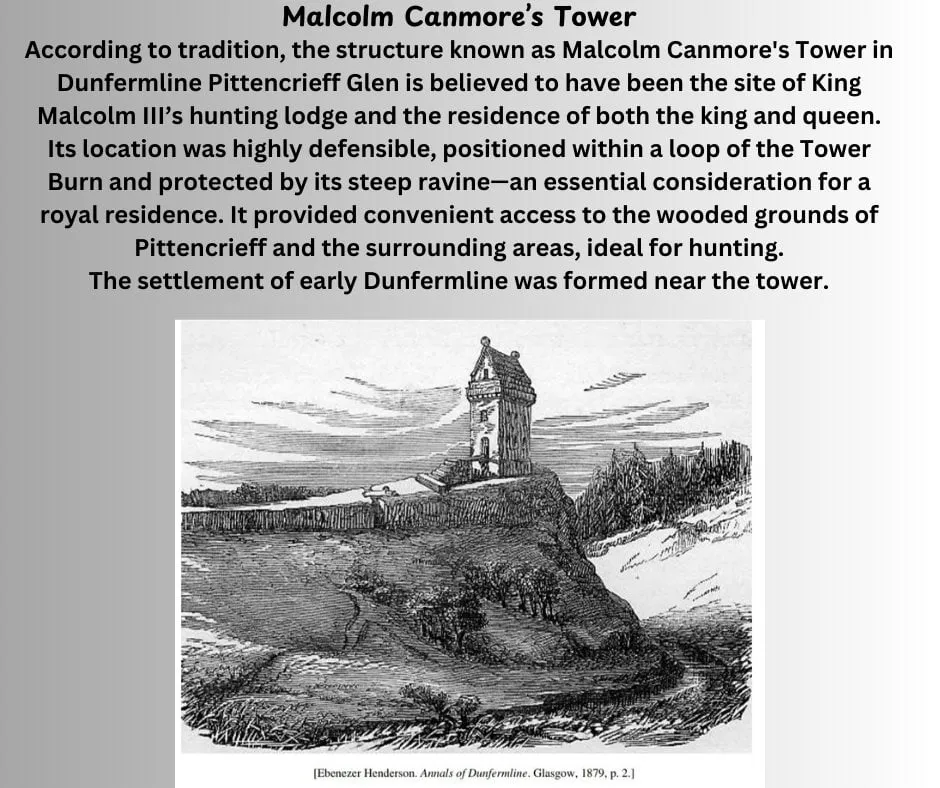
In 1790 John Baine, a civil engineer from Edinburgh, recorded measurements of the remaining walls and produced one of the earliest visual reconstructions of the tower. His drawing was based partly on impressions taken from the burgh seal and partly on comparisons with towers at other Scottish sites such as Forfar. Baine imagined a structure with a projecting staircase leading to the entrance, connected by a small drawbridge that could be raised for protection. He also suggested splayed foundations and outer defensive walls. While these features are plausible for a building of that period, the reconstruction remains largely speculative.
By the 19th century, the ruins had fallen into a neglected condition and were partly hidden by woodland. The tower was not part of Crown property like the Palace and instead belonged to the owners of the Pittencrieff Estate.
In 1843, an excavation by the landowner, Esq. James Hunt produced only charcoal and an iron coin punch (the die), the type used for minting coins. The punch was originally considered to be a forgery, as there was no evidence of a royal mint existing in Dunfermline and no other equipment related to the minting process was found. Initially, it was thought that the item related to the period of Alexander III, but some researchers later attributed it to the reign of David II (1329–1371). The latter dating coincides with the later pottery evidence recovered in 1988. Whether the die belonged to an official mint or was produced by a counterfeiter remains uncertain, but the discovery nevertheless highlights the complex history of the site.
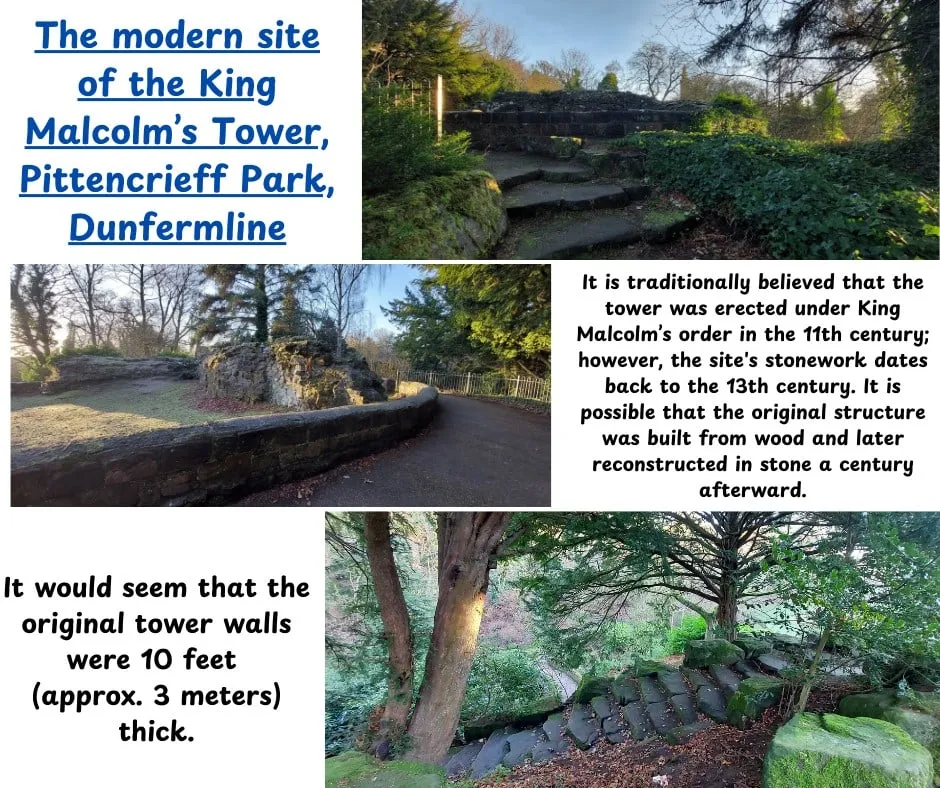
In 1884, the landowner of Pittencrieff undertook restoration work to preserve what remained of the structure. The foundations were cleared, and a low wall was built along the original masonry to protect the ruins. During these excavations, several hewn stones were discovered that closely resembled the stonework used in the nearby palace ruins. This led to the suggestion that the tower may at some point have been dismantled and its materials reused during the construction of the later royal palace.
Further discoveries were made during landscape works in Pittencrieff Glen in the early twentieth century. Following Andrew Carnegie’s purchase of the Pittencrieff Estate, the northern cliff face of Tower Hill was completely refaced artificially and reinforced in 1905 and 1906 to prevent the erosion of the rocks. The large rocks were placed along the Burn. During this work, animal bones “of birds and the lower animals” were discovered, including the jaw bone of a boar and the shoulder blade of a deer, along with fragments of pottery. Also recovered were a small bronze medal and a lead seal marked with the letters “AR.” At the base of Tower Hill the fossilised remains, including the head and part of the vertebrae, of a large reptile were also found.
Evidence suggested that part of the tower may have collapsed into the burn at some point as the hillside gradually crumbled. The improvements to the landscape also revealed traces of coal seams that may have been worked in earlier centuries, possibly by the monks associated with the nearby Abbey.
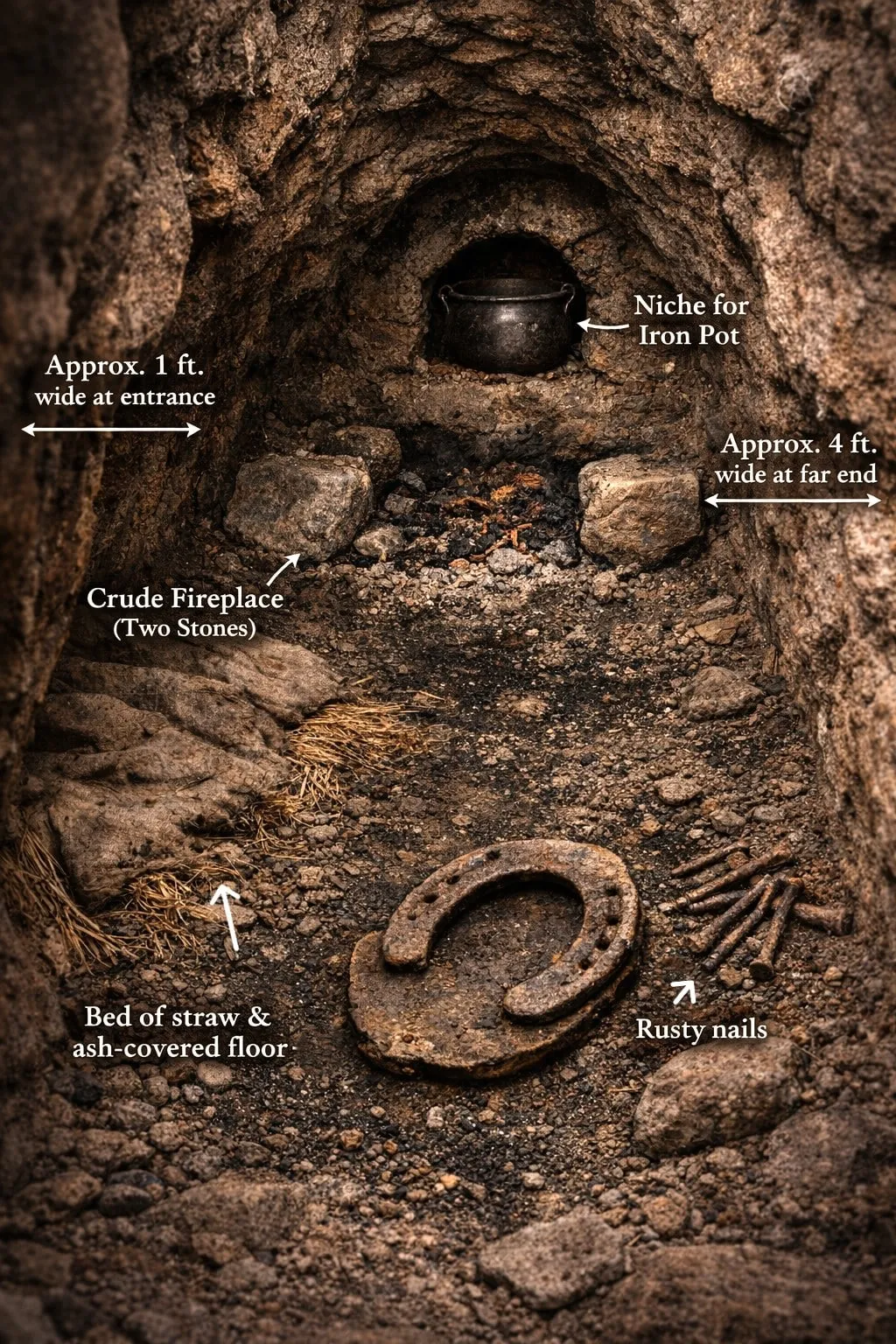
One of the most remarkable findings was a narrow cave in the rock below the tower, which showed clear evidence of human use. Inside the cave were traces of ash, a crude fireplace and stones blackened by heat, along with several nails and a leather horseshoe sole. Some local historians suggested that the cave may once have served as a hiding place for William Wallace during the period when he was in hiding in the area. (We will tell more about this discovery in the next post.)
In the late 20th century, archaeologists attempted to examine the site more systematically. In 1988, the Scottish Urban Archaeological Trust carried out excavations around the tower ruins with funding from the Carnegie Dunfermline Trust. Unfortunately, by that time the site had already been disturbed by centuries of landscaping, excavation and restoration, which made interpretation difficult. The pottery recovered during the excavation suggested that the surviving masonry probably dates from the 14th century rather than from the time of Malcolm III.
If this conclusion is correct, the present remains may represent a later defensive tower built during the turbulent period of the Wars of Independence. During the early 14th century, Dunfermline was an important royal centre. Edward I of England stayed at the Abbey during the winter of 1303 to 1304, and the need to defend the approaches to the burgh and Abbey would have been considerable. Both David II and James I were born in Dunfermline in the fourteenth century, most likely within the Abbey complex that later developed into the royal palace.
A 14th century date for the surviving ruins does not necessarily rule out the existence of an earlier royal residence on the same site. It is therefore possible that an earlier timber structure once stood there and was later replaced by the stone tower whose remains are visible today.
Today, the ruins of Malcolm Canmore Tower are recognised as a Scheduled Ancient Monument by Historic Environment Scotland and remain one of the most significant historical landmarks in Dunfermline. From the summit of Tower Hill, the remarkable view extends towards Dunfermline Abbey, a reminder of the close relationship between royal authority and religious life that shaped the development of the town.
From this rocky stronghold grew the settlement that would become one of Scotland’s most important royal and religious centres.
Although the exact origins and form of Malcolm Canmore’s Tower remain uncertain, its significance to Dunfermline is unquestionable. The tower marks the place where legend, history and landscape meet, preserving the memory of the early royal presence that helped define our city and begin its remarkable story.
Photographs