Historic Dunfermline
Dunfermline’s Christmas Story: from the Newspaper Archives
Before Christmas became the familiar celebration we know today, people in Scotland marked midwinter with ancient festivals such as Yule, a pagan celebration of the winter solstice symbolising the return of the sun. Fires were lit to welcome back light and warmth during the darkest days of the year.
As Christianity spread across Scotland from the 6th century, missionaries such as Saint Columba blended these older customs with Christian beliefs. Christmas entered religious life but remained a minor observance for centuries. During the Protestant Reformation, it was condemned as a Catholic practice and formally outlawed by the Scottish Parliament in 1640, almost disappearing from daily life.
Christmas returned only in the 19th century, influenced by Victorian traditions and the example of Queen Victoria and Prince Albert. Customs such as Christmas trees, gift-giving, and festive meals gradually spread through Scottish society, paving the way for the celebrations that would later take root in towns like Dunfermline.
Even as Victorian Britain embraced Christmas with enthusiasm, Dunfermline at first observed it only partially. For most native-born working-class residents, however, Christmas was still not regarded as a holiday. Work continued as normal, and the day attracted little attention. Some commentators wondered whether Christmas might one day rival Auld Hansel Monday, the traditional Scottish winter holiday, but that moment had not yet arrived. Christmas dinners and suppers were becoming fashionable among Dunfermline’s town gentry, who were quick to adopt English styles of celebration, dress, and speech—sometimes criticised as a rejection of older Scottish customs. Still, it was predicted that these habits would eventually filter down through society.
This period also coincided with a major demographic change. By the 1860s, Irish immigration had reshaped parts of the town. Irish accents were now as common on the High Street as Scottish ones, the upper part of Bruce Street had become an Irish colony, and in western suburbs such as Baldridgeburn and Rumblingwell, traditional Scots speech was rarely heard. Along with new people came new customs, including Christmas, which some feared would one day replace long-established local traditions.
In December 1863, Christmas was celebrated mainly by Episcopalians, and more particularly by the Roman Catholic community. “The streets were lively in the afternoon, filled with Irish lads working in nearby pits, especially around Oakley”. Their celebrations were good-humoured, though sometimes over-spirited. Two young men nearly came to blows on the High Street after drinking, but the chance appearance of their pastor prevented trouble. Acting as a “moral constable,” he intervened and escorted them home. Aside from this incident, Christmas passed peacefully and cheerfully.
By January 1872, it was still the New Year, rather than Christmas, that drew the most attention. Dunfermline marked the season with a grand service of song in Canmore Street Chapel, well-attended concerts in the Music Hall and St Margaret’s Hall, and a highly successful Ornithological Society exhibition. These events reflected a growing appetite for communal winter celebrations, even if Christmas itself remained secondary.
In December 1881, Christmas was still only partially observed. Shops and houses were decorated with holly and evergreens, shop windows displayed beautiful and often costly gifts, and the banks closed for the day, but everyday work continued. The streets were busy with people going about their normal business, a clear sign that Christmas had not yet become a full public holiday.
Even so, festive signs were unmistakable. Shop windows drew large crowds late into the evening with carefully arranged displays of useful and ornamental goods. A keen frost added to the seasonal atmosphere, making conditions ideal for walking and shopping. Bazaars were crowded well into the night, and shopkeepers reported unusually brisk trade.
The Post Office experienced a remarkable surge in activity as the custom of sending Christmas cards took hold. Never before had so many cards been posted, and extra staff were hired to cope with the demand. Railway stations were similarly overwhelmed, with increased passenger traffic causing trains to run late.
Churches continued to play an important role in Christmas observance. Episcopal and Roman Catholic services were well attended. In the Episcopal Church, Holy Communion was celebrated amid elaborate decorations of stars, wreaths, and evergreens, along with floral displays of camellias and chrysanthemums along the altar rail. The music was bright and carefully chosen, and offertory collections were devoted to improving the church organ. At St Margaret’s Church, early morning Mass was celebrated, reflecting the importance of Christmas within the Catholic community.
Charitable traditions were also taking firm root. In December 1888, between 300 and 400 poor children were treated to a free Christmas dinner in St Margaret’s Hall, with gifts distributed under the supervision of Mrs Russell of Craiglhu. This spirit of generosity would become one of Dunfermline’s most enduring Christmas customs.
By the turn of the century, Christmas had also become associated with civic generosity on a grand scale. In December 1899, Dunfermline received its most generous Christmas gift when Andrew Carnegie announced a donation of £20,000 to provide swimming baths and a gymnasium for the town, describing it as a Christmas gift from “its loyal son.”
Not everyone welcomed the growing celebration. In December 1901, the Rev. Jacob Primmer delivered a fierce sermon condemning Christmas as a revival of paganism. He criticised festive excess, concerts, decorations, and even church celebrations, warning that divine judgement awaited those who embraced such practices. This opposition continued into January 1908, when the Dunfermline Protestant Defence Association formally protested against Christmas observance in Protestant churches, viewing it as a sign of religious decline and imitation of Catholic traditions.
Despite this resistance, Christmas celebrations continued to grow. In December 1908, a “pleasing spectacle” took place in the Drill Hall on Bruce Street, where around 1,100 children attended the annual Christmas treat. Organised by Mrs William Robertson and supported by Chief Constable Bruce and the City Police, the event featured music, attentive stewards, and a Christmas tree for the children of the Loyal Order of Ancient Shepherds. Built in 1887, the Drill Hall—once central to the town’s defence—had become a place of warmth and joy.
By December 1911, Christmas was a quieter public holiday. Work continued as usual, except at banks and public offices, which closed for the day. While the Police Court was busy following a Saturday night, serious crime was notably absent. Meanwhile, the Post Office and railway stations recorded record levels of activity, showing how deeply seasonal travel and communication had become part of Christmas.
That year also highlighted Dunfermline’s commitment to caring for the less fortunate. Despite Andrew Carnegie’s Trust providing substantial income for public benefit, many families still struggled. The parents of 130 children applied for a special Christmas treat organised by Chief Constable Bruce. Pastry and fruit were served freely, and the children enjoyed a concert and a cinematograph show. When hundreds of additional children gathered outside the Drill Hall without tickets, each was given a bag of pastry—a small gesture that spoke volumes about the town’s generosity.
Community celebrations continued to expand. In December 1936, the Dunfermline City Police held their annual social and Christmas tree celebration in the Co-operative Tea Rooms, featuring dancing, games, live music, and a visit from Santa Claus, played by Constable A. S. Scott.
The Christmas tree itself, a Victorian custom, became a central symbol of the season—sometimes bringing trouble as well as joy. In January 1947, four boys appeared before the Juvenile Court for cutting down spruce trees near Pitreavie to use as Christmas trees. While punished, the court acknowledged that the season may have tempted them. Similar incidents occurred in December 1950, when a local miner was fined for taking part of a fir tree home, believing he was doing no harm.
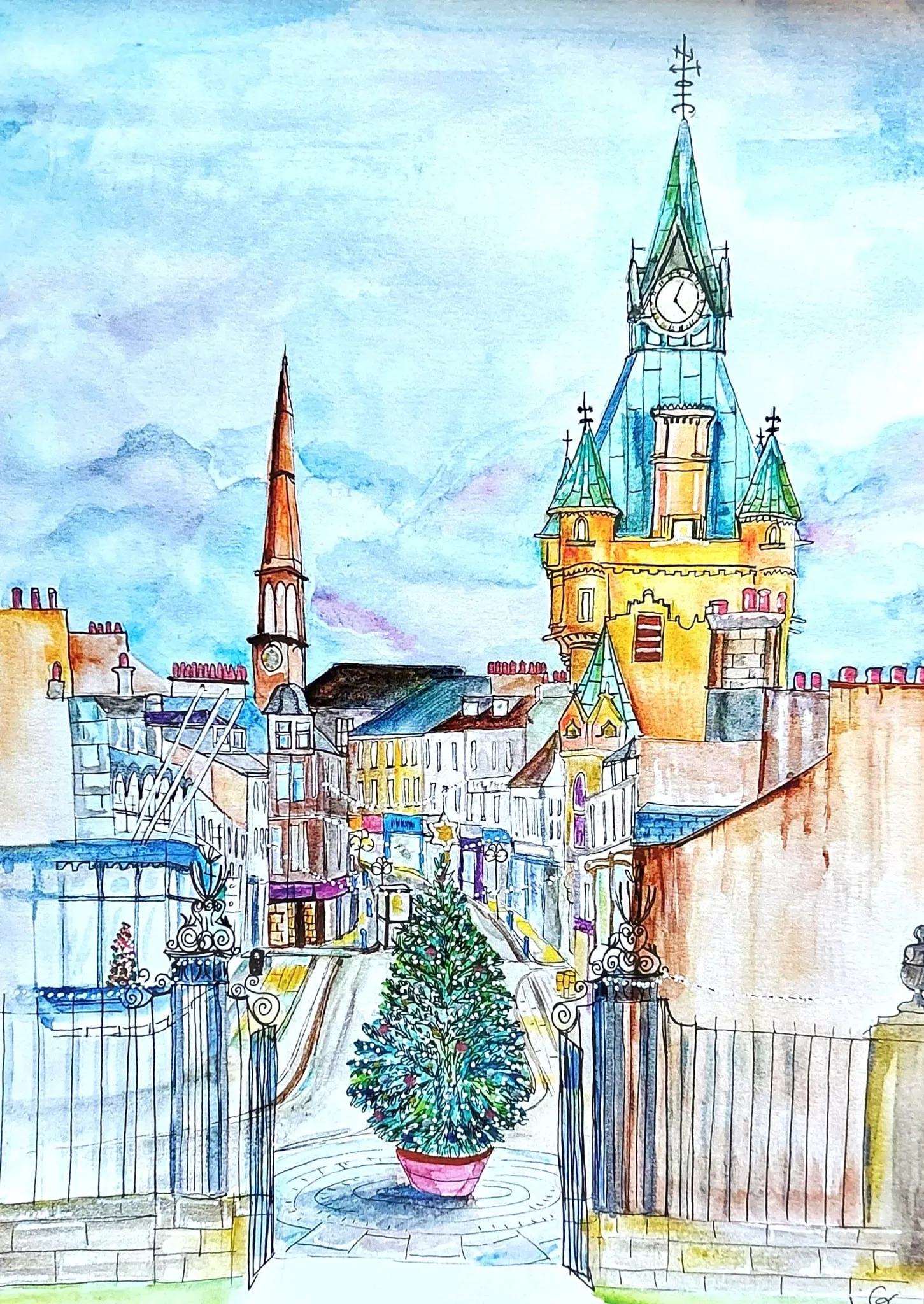
That same year, the Christmas tree tradition took on new civic importance. The Carnegie Dunfermline Trust gifted a large, brilliantly lit Christmas tree to stand at the Bridge Street entrance to Pittencrieff Park.🎄 Members of the Dunfermline Soroptimists—an international organisation supporting education for girls and women—volunteered their time beside the tree, collecting toys, books, sweets, and donations for children who might otherwise go without. Although displayed for only a week, from 18 to 23 December, it appears to have been Dunfermline’s first public outdoor Christmas tree and brought immense joy, especially to children from poorer families.
By 1988, Dunfermline faced a modern challenge: vandalism. For years, the public Christmas tree at the gates of Dunfermline Glen suffered repeated damage. The council tried relocating it to Carnegie Hall, but even there the tree was attacked. Eventually, it was returned to its original site with protective measures, including coloured bulb covers designed to deter vandals. Though costly, these steps were considered necessary to preserve a tradition that brought joy to thousands.
Today, Dunfermline proudly carries these traditions forward. The town’s Christmas tree once again stands at the main entrance to the Glen, a symbol of continuity, community, and festive hope. From late November onwards, shops, businesses, and venues begin decorating their premises, filling the streets with light and colour. These decorations brighten the darkest days of winter and bring people together—families, friends, and neighbours—sharing in the warmth, generosity, and quiet hope that Christmas has come to represent in Dunfermline.🌟
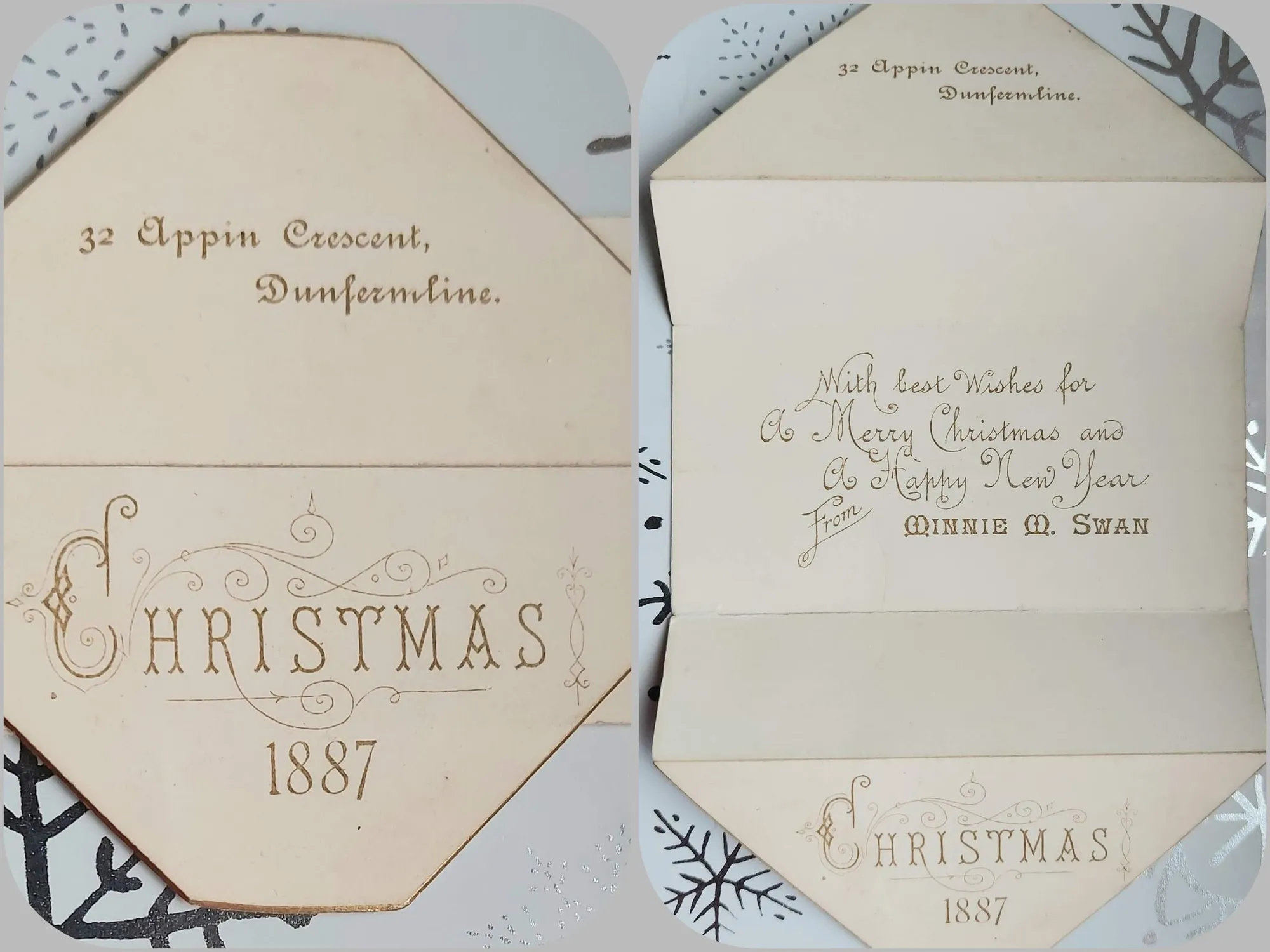
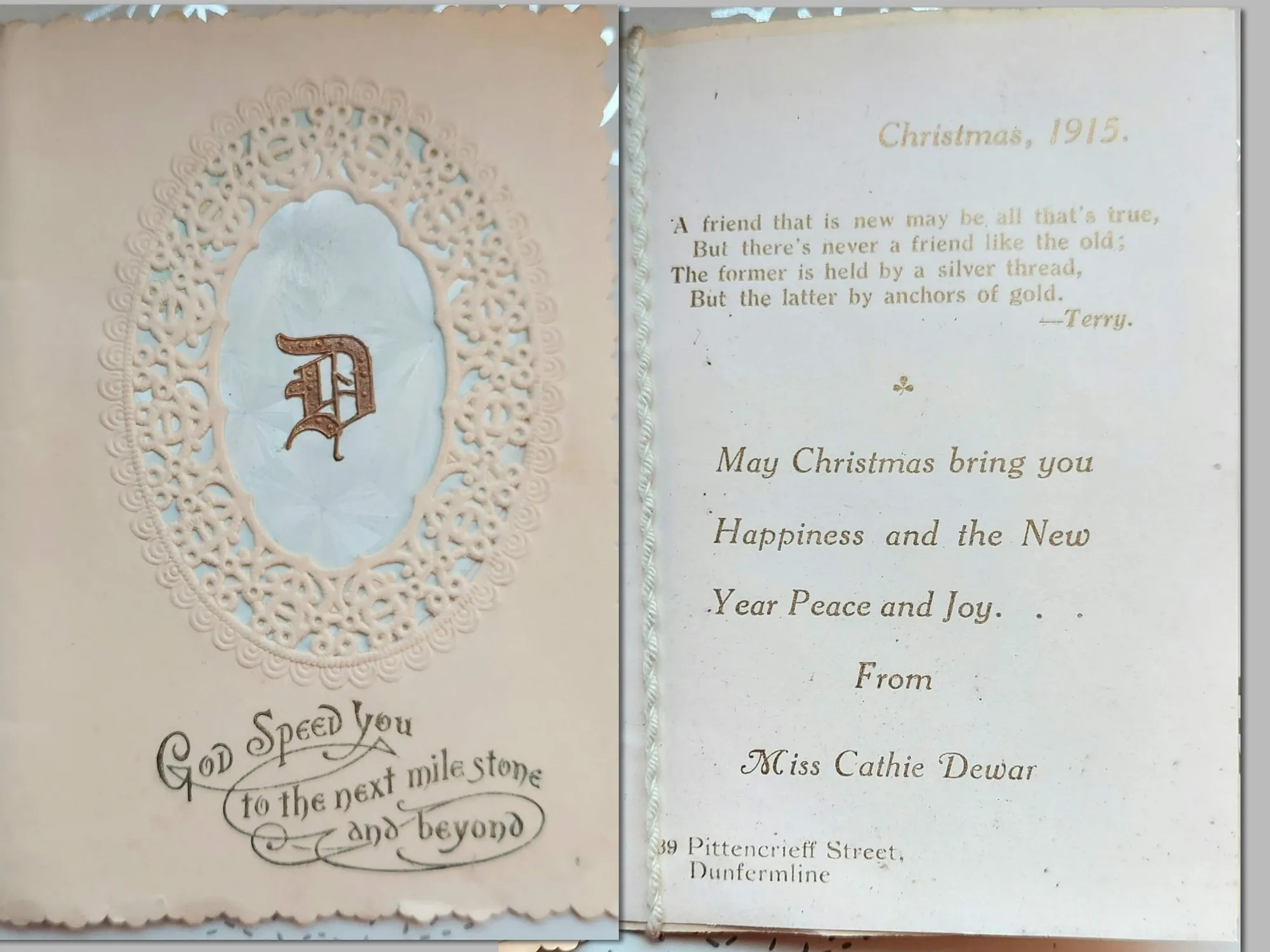
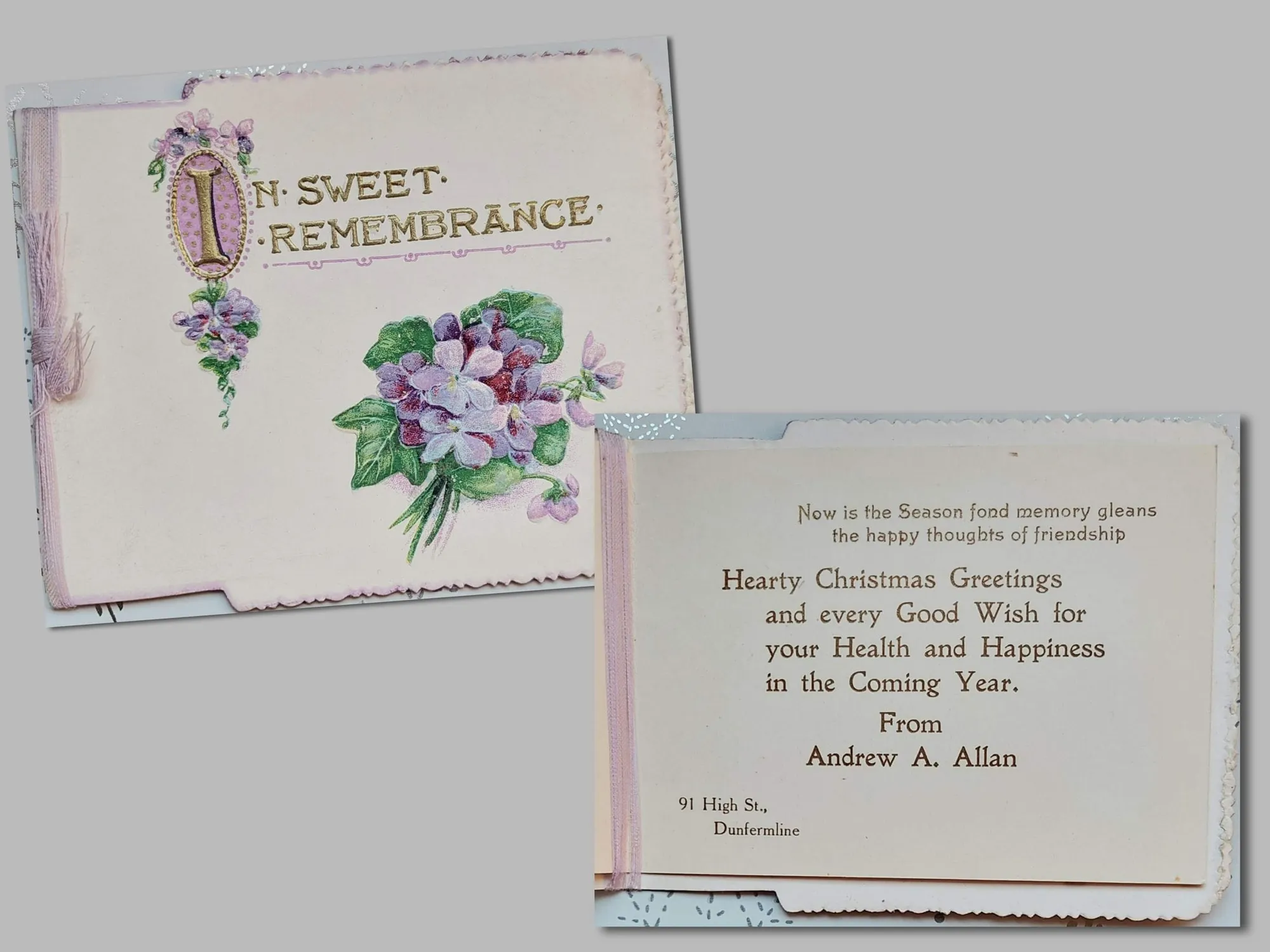
Images: copy of the print by Dunfermline Artist Laura Gillespie, 2024; old Dunfermline Christmas Cards.
Photographs