Historic Dunfermline
The Deaths and Burials of Malcolm Canmore and Queen Margaret
Both Malcolm Canmore and Queen Margaret were buried in Dunfermline, having died just days apart. Malcolm was treacherously betrayed and killed at the Battle of Alnwick, and Margaret succumbed shortly after hearing the news of his death. By this time, Malcolm’s brother, Donald Bane, had already gathered troops to seize the Scottish throne and oust his nephews. Fearing that Margaret’s body could not be safely transferred to her desired resting place—the Church of the Holy Trinity, which Malcolm had built for her in Dunfermline—a plan was devised. Thanks to the unexpected intervention of a heavy mist, her body was safely transported across the Forth by ferry and laid to rest in her small church before the altar. Over time, this location became, or was replaced by, the High Altar of the nave.
Malcolm was initially buried at Tynemouth Priory, but in 1115, his body was exhumed and reinterred in Dunfermline Abbey, beside Margaret.
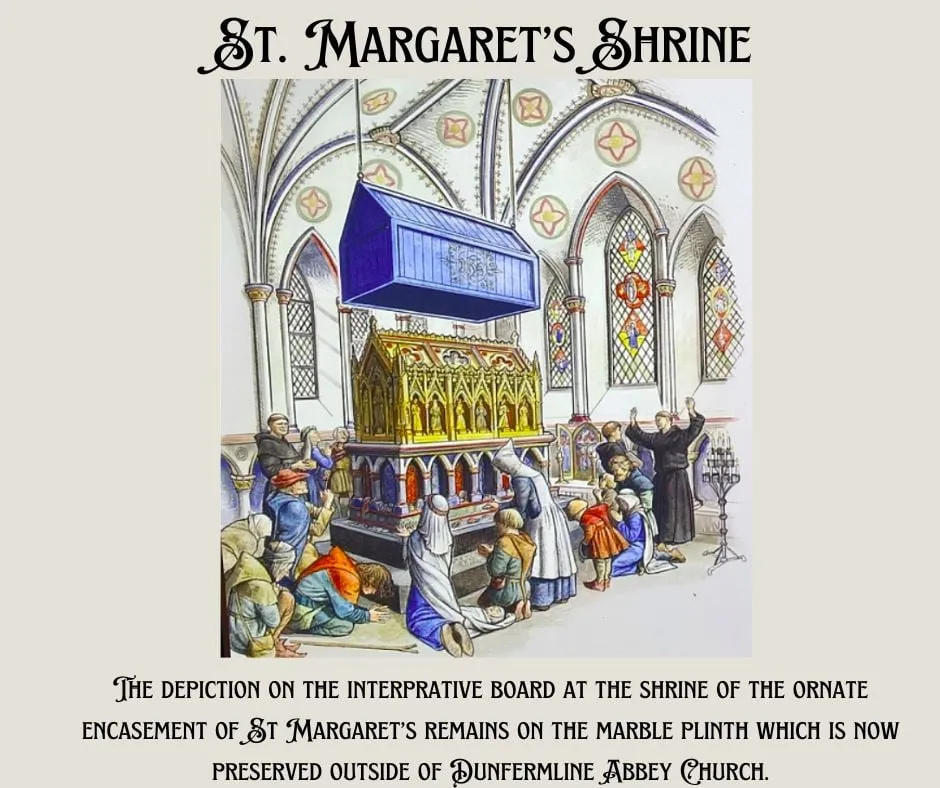
In 1250, Pope Innocent IV canonized St. Margaret. To honor her sainthood, a rich and radiant shrine was prepared in the Lady Chapel (on the eastern side of the current Abbey Church). Her remains, after resting for 157 years, were exhumed and placed in a receptacle befitting such precious relics. Some of the later chronicles describe the shrine as grand and magnificent, with a marble base. According to tradition, when her grave was opened, Margaret’s body was found uncorrupted: her blond hair flowed over her shoulders, and a sweet and pleasant fragrance emanated from her burial site.
The story further relates that as Margaret’s body was being lifted, it became impossibly heavy near the grave of King Malcolm, preventing the bearers from moving further. It was then decided to exhume Malcolm’s remains and place them in the chapel beside his wife. A few centuries later, the remains of both royals were moved again to safeguard them from Protestant reformers.
Of the foundation walls of the Lady Chapel as they exist today, only a few areas of the original masonry survive. Much of the masonry now visible consists of repairs carried out at a much later date—likely during the construction of the new church in 1818.