Historic Dunfermline
The Schaw Monument in Dunfermline Abbey
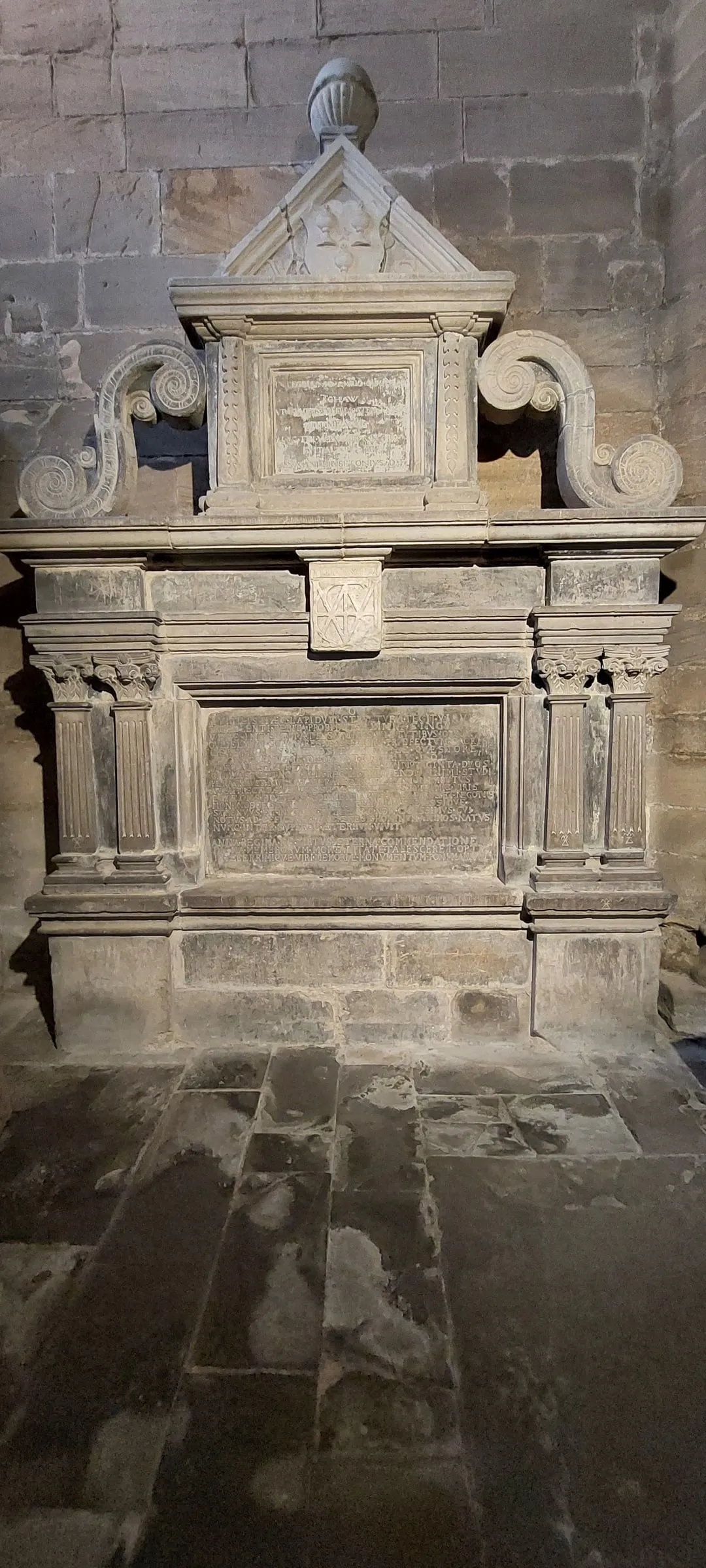
William Schaw’s high status is reflected in the tomb erected in his honour at the royal Abbey of Dunfermline—an elaborate and dignified monument ordered by Queen Anne of Denmark herself.
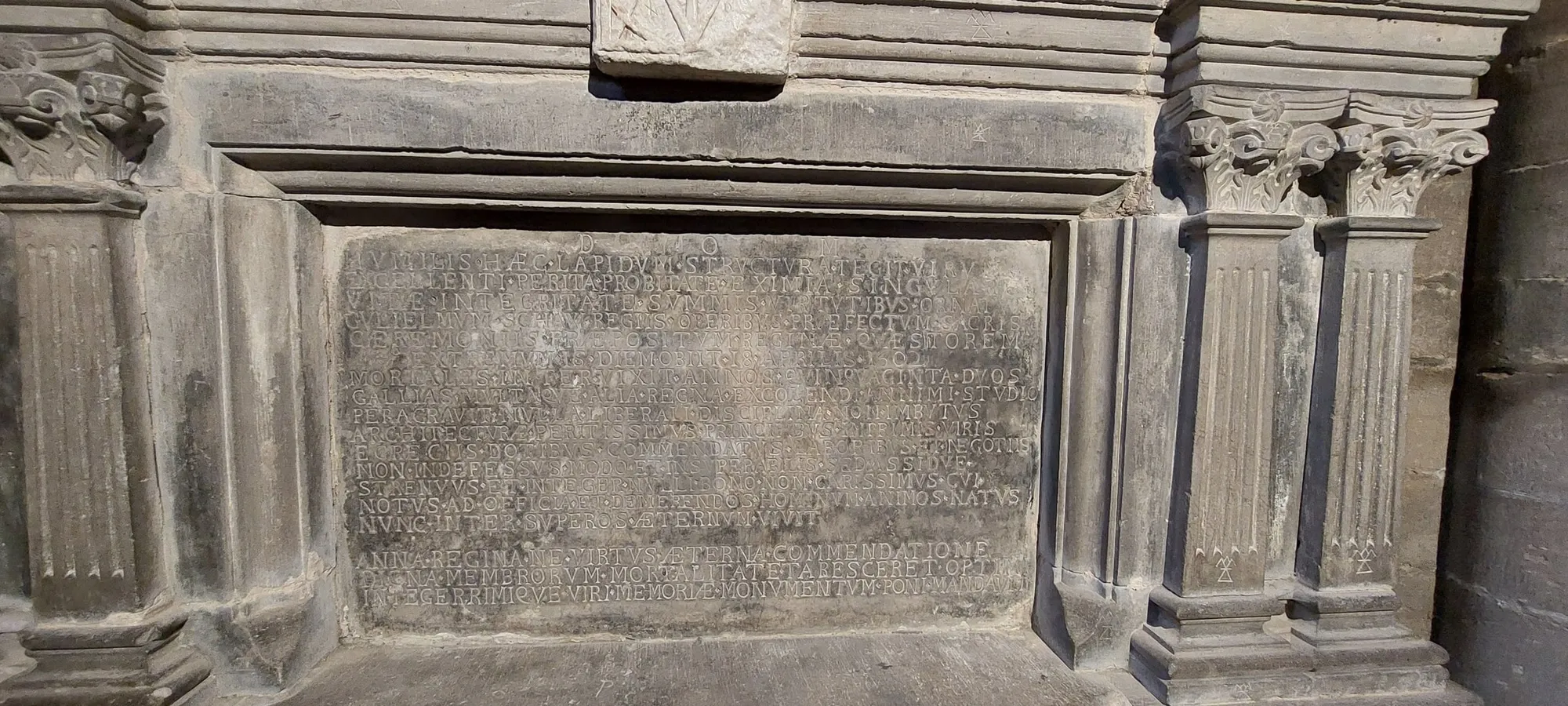
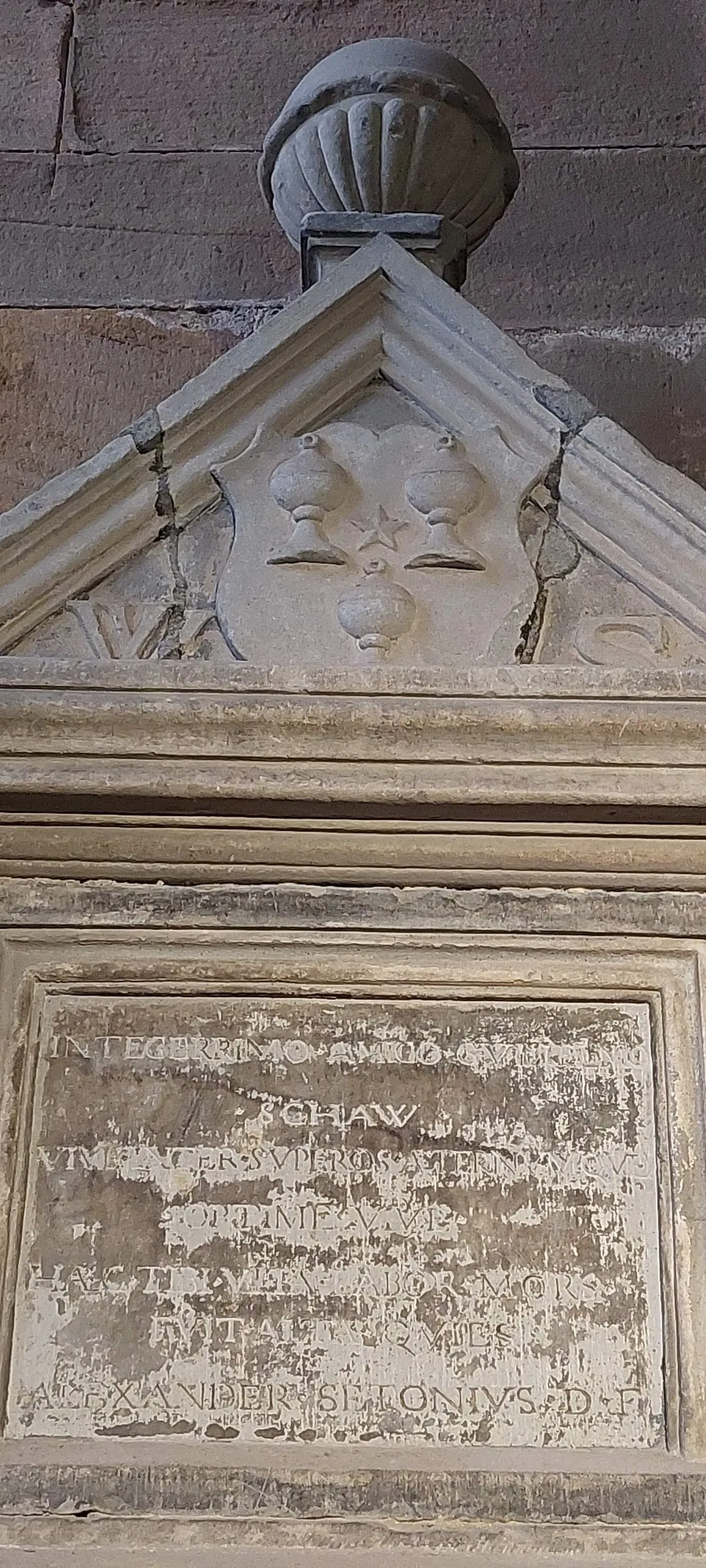
The monument to his memory now stands under the north-west tower of the abbey, having been relocated there in 1794 from a position further east in the nave. The tomb is a Classical-style wall monument built of freestone. It features short Composite pilasters flanking a long Latin epitaph that describes Schaw as a “most skilful architect”. A second Latin panel at the top is supported by heavy scrolled brackets and surmounted by a triangular pediment containing a coat of arms: a star between three covered cups—a variation of the Schaw family arms.
These heraldic elements—Azure, three covered cups with a mullet for difference—reflect Schaw’s descent from the Schaws of Sauchie. Although there is no record of an official grant of arms to William Schaw, the addition of the mullet (a five-pointed star) signifies his position as a third son, and the arms may have been used as a personal or assumed device.
The uppermost Latin inscription records Schaw’s close friendship with Alexander Seton, later the first Earl of Dunfermline, who likely had a hand in commissioning the monument.
“To his most excellent friend, William Schaw,
Live with the Gods, thou Worthy, live forever;
From this laborious life, Death now doth thee deliver.
Deo Optimo Maximo (To God, the Best and Greatest of Beings).”
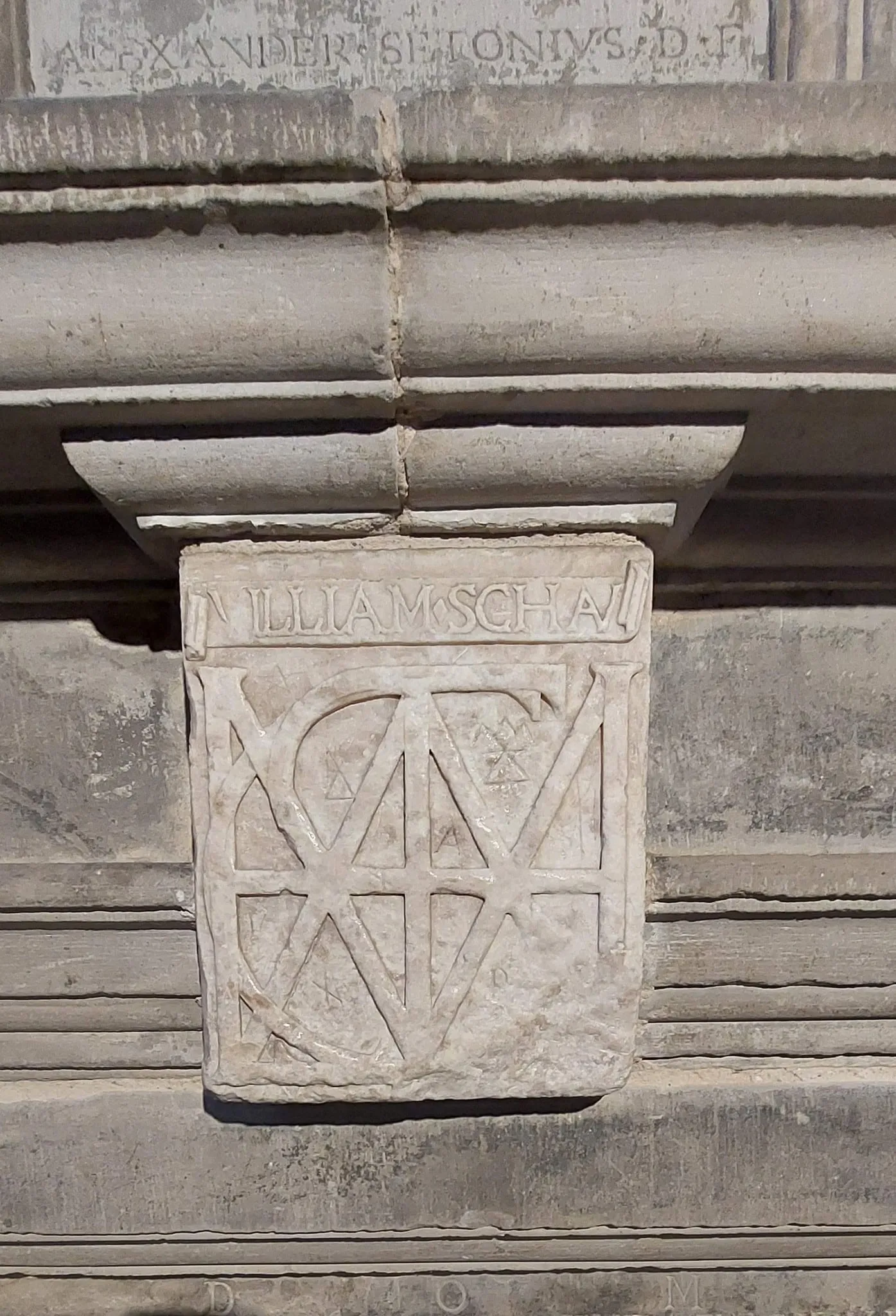
Notably, Schaw’s name appears twice in the entablature—once spelled out in full, and once as a distinctive white marble monogram, with all the letters of his name artistically interlaced. Below this are two masons’ marks, prominently carved on pilaster capitals, bases, and the marble panel. However, these are not Schaw’s own mark, but those of the craftsman who constructed the tomb and his assistant.
The mason was David Scougal of Crail, whose authorship is confirmed by comparison with another signed tomb: that of James, 7th Earl of Glencairn and his wife Margaret, in the Glencairn Aisle of St Maurs in Kilmaurs, dated 1600.
Queen Anne’s tribute to Schaw was more than personal—it was symbolic.
“This small structure of stones covers a man of excellent skill, notable probity, singular integrity of life, adorned with the greatest virtues: William Schaw, Master of the King’s Works, Master of the Sacred Ceremonies, and the Queen’s Chamberlain. He died 18th April 1602. Among the living, he dwelt 52 years. He had travelled France and many other kingdoms for the improvement of his mind; he lacked no liberal art or science; he was most skilful in architecture; he was early recommended to great persons for the singular gifts of his mind. He was not only unwearied in labours and business, and insuperable, but daily strenuous and strong. He was most dear to every good man who knew him. He was born to do good offices, and thereby to fuse the hearts of men. He now lives eternally with God”.
“Queen Anne caused this monument to be erected to the memory of this most excellent and most upright man, lest his virtues, which deserve eternal commendation, should fade or decay with the mortality of his body.”
The inclusion of Schaw’s mason’s mark in a central monogram, repeated throughout the structure, further elevates the symbolism of his life’s work. Though the actual funeral proceedings are lost to history, one can imagine the ritual and reverence surrounding a man held in such esteem by the royal court and the wider mason craft. It’s likely his tomb, richly ornamented and proudly marked, served not just as a memorial, but as a rallying point for masons to pay homage, perhaps in full ceremonial dress, laying rosemary and laurel in his honour.
Specific architectural information was obtained from the Church Monuments Society website (https://churchmonumentssociety.org/), in an article published by Dr. Jennifer Alexander in January 2011.
Photographs