Historic Dunfermline
Anne of Denmark: Dunfermline’s Last Queen
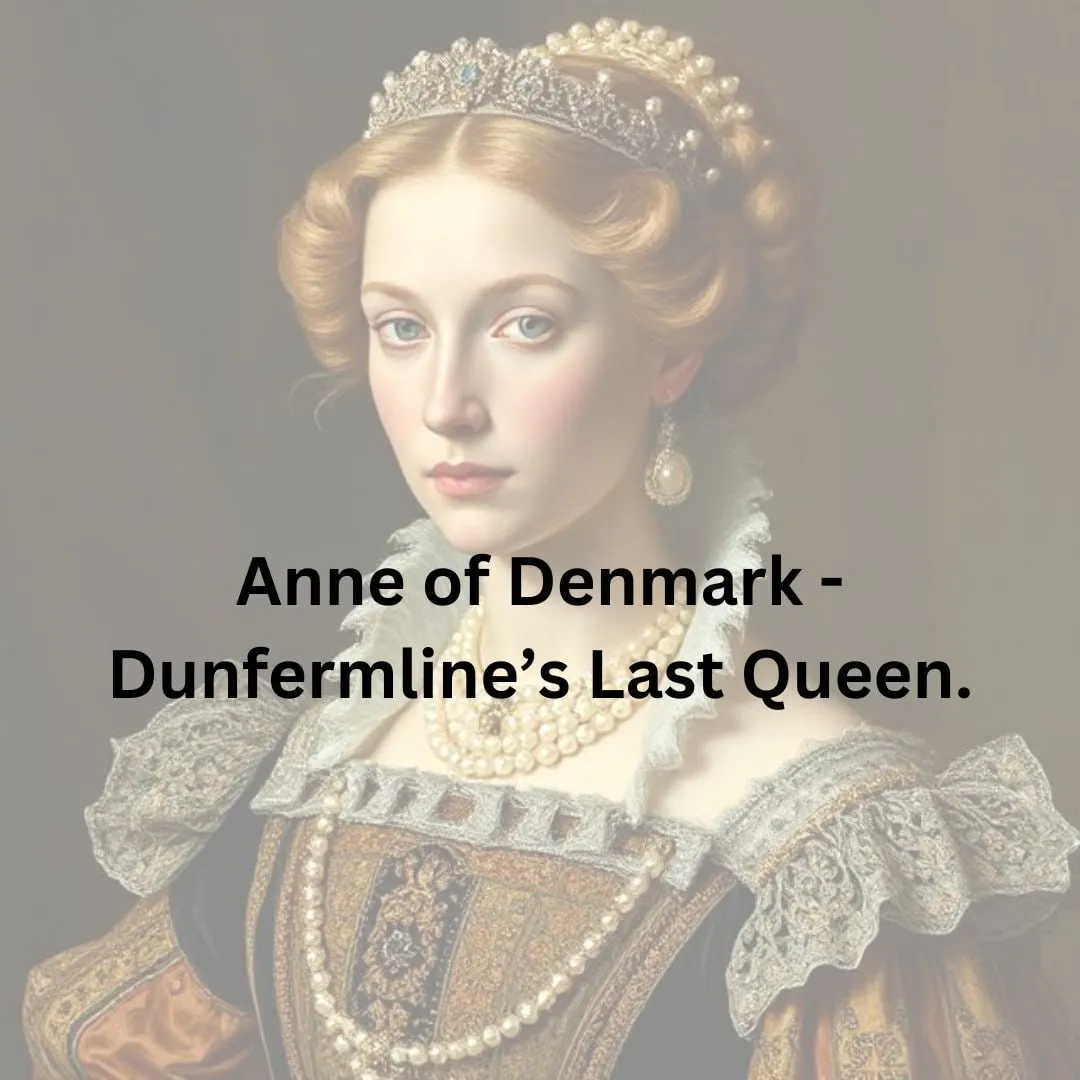
Anne was born on 12 December 1574 at Skanderborg Castle in Denmark, the daughter of King Frederick II of Denmark and Norway and Sophia of Mecklenburg-Schwerin. In August 1589, at just 14 years old, she was married by proxy to 23-year-old James VI of Scotland. From James’s perspective, Anne was an ideal match—young and attractive, Protestant (which pleased post-Reformation Scotland), Scandinavian (which bolstered Scottish trade), and accompanied by a substantial dowry of £150,000.
However, Anne’s journey to Scotland was fraught with difficulty. A violent storm forced her fleet to seek refuge in Norway, leading James to personally travel there to bring her home. They were married in person in Oslo on 23 November 1589 and again in January 1590 at Kronborg Castle in Denmark. After spending several months honeymooning in Norway, the couple finally arrived in Leith on 1 May 1590, enduring yet another stormy crossing of the North Sea. Anne was crowned Queen of Scotland on 17 May 1590 at Holyrood Abbey. The belief that these storms were caused by witchcraft led James to launch an infamous witch-hunt, resulting in the execution of over a thousand accused witches across the following century.
The day after their wedding, James presented Anne with one of the royal houses in Dunfermline as a “morning gift.” Later, she was granted the Lordship of Dunfermline and styled herself as Lady Dunfermline. History records that from the 18th of July 1590 to the 26th of September, eight feather beds were furnished to the Palace of Dunfermline for the strangers in His Majesty’s company, each costing one shilling per night. Additionally, six chambers in the town were furnished, each containing two feather beds and provisions of coal and candle, for which the nightly charge was five shillings and seven pence.
She developed a deep fondness for the town, as a few years later, she had the old house rebuilt. Known as the Queen’s House, it stood between the palace and the town’s port of St. Catherine, featuring three stories and a pend (arched passage) leading to the palace’s main courtyard.
When the royal court resided at Dunfermline Palace, Anne may have found refuge in the Queen’s House, relishing its less formal atmosphere—much like how Marie Antoinette later sought solace at the Petit Trianon. In the early years of their marriage, Anne and James seemed happy together. She was a striking young woman with a dazzlingly fair complexion, blue eyes, and long golden hair. However, James later found her to be somewhat foolish. She enjoyed gaiety, participating in lavish masques, dancing, and even skipping with a rope. At just fifteen years old when she married, Anne quickly had to transition into the responsibilities of a wife, queen, and mother.
Anne and James had seven children, three of whom were born at Dunfermline Palace: Elizabeth, who later became the “Winter Queen” of Bohemia; Charles, who would eventually become Charles I; and little Robert, who died in infancy and was buried with his ancestors in the ruined abbey. A peculiar story surrounds the childhood of Charles I. As an infant, he was often restless, disturbing his parents with his cries.
One night, his nurse shrieked in terror, awakening the King, who rushed to the child’s chamber.
“Hout, tout, what’s the matter wi’ you, nursie?” James demanded.
“Oh!” the nurse exclaimed, wringing her hands. “There was one like an auld man who came into the room, threw his cloak over the prince’s cradle, and then drew it back as if to take cradle, bairn, and all away with him! I fear it was the thing that’s no canny!”
“Fiend take him! Would he had ta’en the girning brat clean awa’!” James scoffed. “Gin he ever be king, there’ll be nae gude in his reign—the deil has cassen his cloak ower him already.”
James’s deep interest in demonology makes his reaction particularly eerie, and in hindsight, history does not look kindly upon Charles I’s reign.
While awaiting news of Queen Elizabeth I’s death and their eventual ascension to the English throne, James and Anne’s relationship began to fray. James resented Anne’s extravagance, while she criticized his crude table manners and his apparent interest in handsome young men. When they finally traveled south to claim the English crown, they maintained separate households, living independent lives that ultimately harmed their children’s well-being.
By the mid-1590s, Anne had converted to Catholicism, causing political strain in Presbyterian Scotland and deepening the rift in her marriage. Over time, she spent more and more of her days at Dunfermline Palace, living separately from James. Nonetheless, she accompanied him to England in 1603, where they were crowned King and Queen of England on 25 July at Windsor Castle. However, during the ceremony, Anne caused controversy by refusing to take Anglican Communion.
Anne thrived in London society, indulging in extravagant entertainments and lavish court functions. She developed a passion for expensive clothing and architectural projects, further straining the royal treasury and her relationship with James. Her world was shattered in November 1612 when her beloved son, Henry Frederick, Prince of Wales, died of typhoid. Just months later, in February 1613, her daughter Elizabeth married Frederick, Elector Palatine, on her way to becoming the Queen of Bohemia. Anne’s health began to decline, and she died on 2 March 1619 at Hampton Court Palace. She was later buried in Westminster Abbey.
The citizens of Dunfermline likely mourned Anne’s passing, pausing their work at the hand looms to remember their former queen. Over time, the Queen’s House fell into ruin, eventually serving as a poorly run school for boys and girls, and later, as a venue for cockfighting. The once-grand building was eventually removed altogether. Like the Queen’s House, Dunfermline Palace itself was allowed to decay. Today, only its tall, gaunt walls remain, where pigeons flutter through empty windows. No one remembers the queens who once ruled there, the warmth of the great halls filled with music, nor the laughter of royal children. Only this fading tapestry of history remains.
ℹ️This image is an AI-generated representation based on a description of a historical figure.