Historic Dunfermline
Elizabeth de Burgh: the Captive Queen
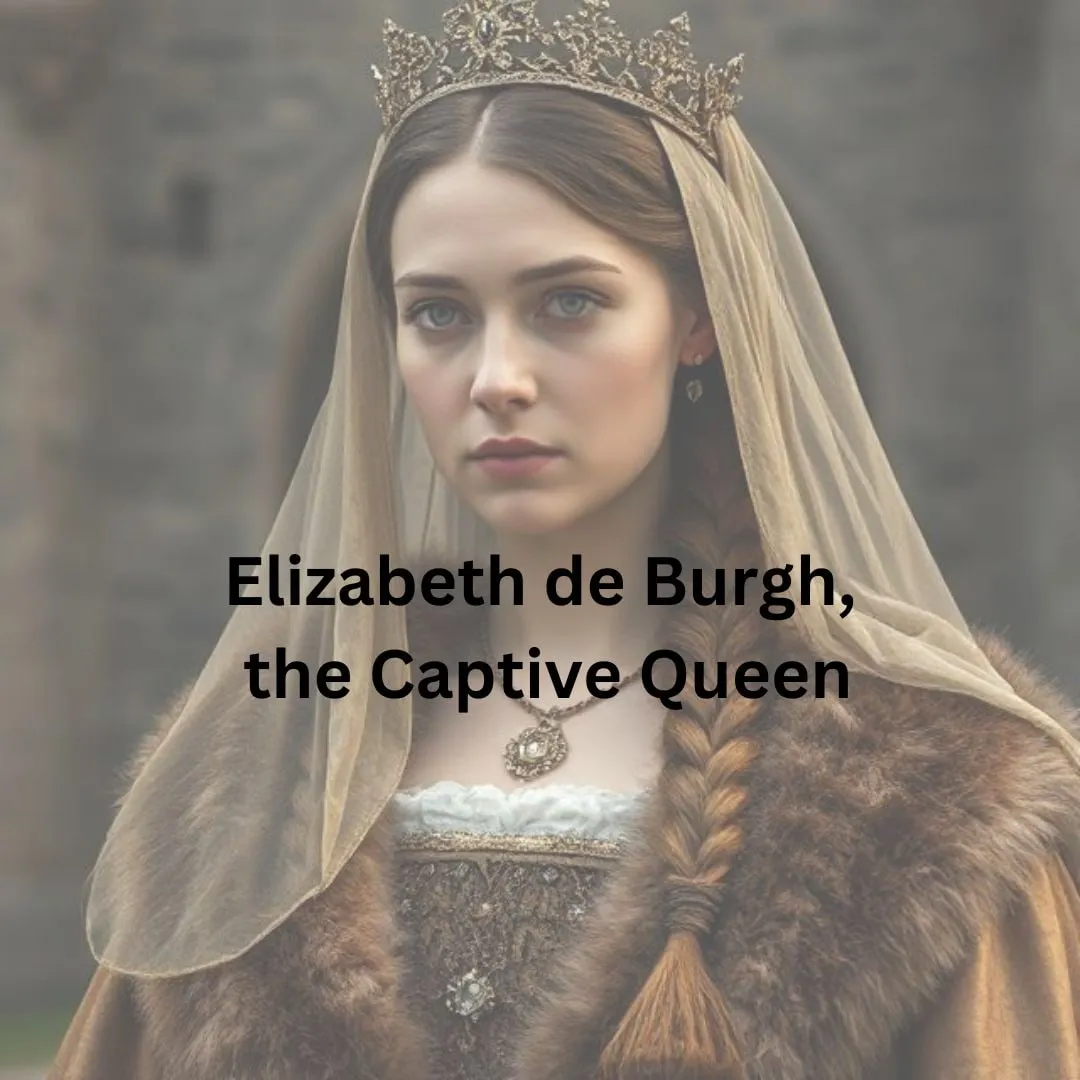
Elizabeth de Burgh was born around 1289, the daughter of Richard de Burgh, Earl of Ulster and Connaught, and his wife, Margaret. She was also a goddaughter of England’s King Edward I. At the age of 13, in 1302, Elizabeth was married to Robert the Bruce, Earl of Carrick. The marriage was likely arranged by Edward I, who certainly encouraged it as a means of securing Robert’s loyalty to the English crown.
However, political events in Scotland soon drove Robert away from his English alliances. In 1306, he murdered his greatest rival for the Scottish throne, John Comyn, in the Chapel of the Greyfriars in Dumfries. Realizing that he would face excommunication for his actions, Robert rushed to Scone to be crowned before a papal bull could be issued against him.
Six weeks later, on March 25, 1306, Robert was crowned King Robert I of Scotland, with Elizabeth at his side. A second coronation ceremony took place the following day, presided over by William Lamberton, Bishop of St Andrews, who had arrived too late for the first. Elizabeth is said to have remarked that she and Robert were like “the king and queen of the May.” This phrase is often interpreted as a criticism of her husband’s uncertain hold on power, though it may also have been an ominous foreshadowing of the struggles ahead.
The coronation did not bring stability. Instead, Robert and his supporters faced immediate challenges. An aging but determined Edward I dispatched his loyal commander, Aymer de Valence, to Scotland. In June 1306, de Valence defeated Robert’s forces at the Battle of Methven. With Robert on the run, his wife and other female relatives needed to be taken to safety. Robert’s brother, Neil, and the Earl of Atholl escorted Elizabeth, along with Princess Marjorie (Robert’s daughter from his first marriage), his sisters Mary and Christian, and Isabella, Countess of Buchan, northward toward Orkney.
However, they were intercepted and captured by William, Earl of Ross, a supporter of the deposed King John Balliol. Seeking to curry favor with Edward I, Ross handed the captives over to the English. Elizabeth and her companions were taken south to Lanercost Priory, where Edward I was residing.
Elizabeth’s capture was a significant blow to Robert. The newly crowned King of Scotland still had no male heir, and with Elizabeth in English hands, his hold on the throne became even more precarious. Edward I was known for his harsh treatment of Scottish prisoners, a reputation underscored by historian Sir Maurice Powicke, who described Edward’s approach as one of “peculiar ferocity.” However, Elizabeth was treated more leniently than her companions, likely due to her father’s close alliance with Edward. The English king refused to acknowledge her as Queen of Scots, referring to her instead as the Countess of Carrick, Robert’s title before his coronation.
Elizabeth was initially imprisoned at Burstwick Manor in Holderness, Yorkshire. From there, she wrote to Edward, in an undated letter, complaining that she possessed only three changes of clothing and no bed linen. Afterward, she spent four years in confinement at Bisham Manor in Berkshire. As Robert’s fortunes improved, however, her captivity grew more severe. In 1312, when Robert’s forces raided Yorkshire, she was moved to a more secure location and held at various sites in southern England, including Windsor Castle. By this time, she was permitted six attendants and received a regular allowance. Later, she was transferred to Shaftesbury Abbey in Dorset.
In 1314, Robert the Bruce secured a decisive victory at the Battle of Bannockburn against Edward II and his English forces. The triumph led to the capture of several prominent English nobles, including Humphrey de Bohun, Earl of Hereford. This provided Robert with leverage to negotiate a prisoner exchange. As a result, Elizabeth and the other Bruce women were released after eight years of captivity and returned to Scotland.
Reunited at last, Robert set about consolidating his kingdom, with Elizabeth by his side. Between 1315 and 1323, the couple had two daughters. Margaret, who married William, 5th Earl of Sutherland, died in childbirth in 1346 or 1347. Matilda married Thomas Isaac, had two daughters, and passed away in 1353. Their long-awaited son, David, was born in 1324. In 1328, he was married to Joan of the Tower, daughter of Edward II of England. Following Robert’s death in 1329, David ascended the throne as King David II at the age of five. The couple also had a second son, John, born in or before 1327, but he died young.
Elizabeth herself passed away on October 27, 1327, at the age of approximately 38, at the royal residence in Cullen, Banffshire. Given that her younger son may have been born—and died—the same year, it is possible that complications from childbirth contributed to her death. She was laid to rest in Dunfermline Abbey, where Robert the Bruce was interred beside her when he died 18 months later.
ℹ️This image is an AI-generated representation based on a description of a historical figure.