Historic Dunfermline
Annabella Drummond: from Dunfermline to the Throne
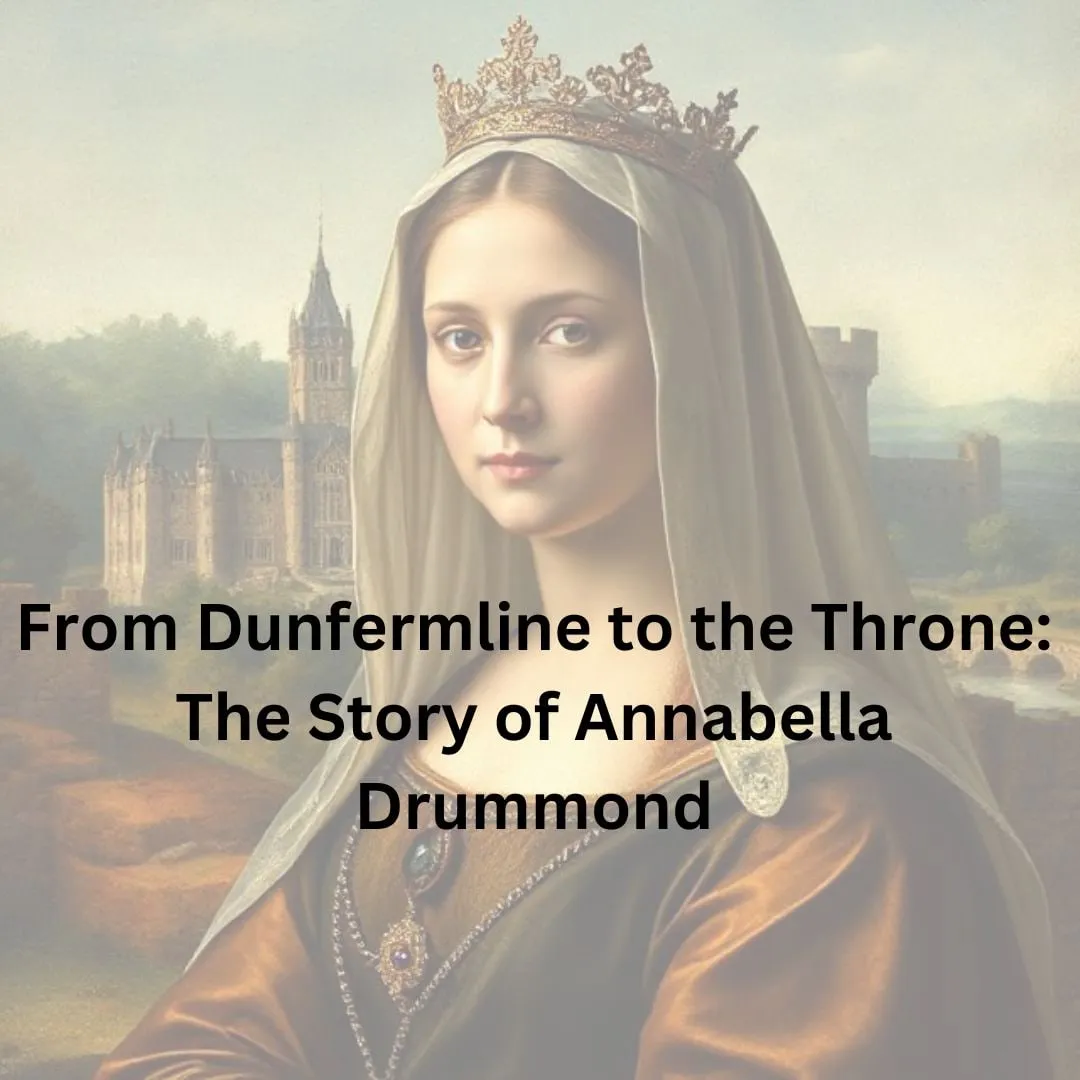
Annabella Drummond (c. 1350–1401), the daughter of Sir John Drummond of Stobhall and Mary Montfichet, is believed to be born in Dunfermline Abbey. She became the Queen Consort of Scotland as the wife of Robert III of Scotland. She was the niece of David II’s second queen, Margaret.
Annabella married John Stewart, the future Robert III of Scotland, in 1367. Their marriage was initially marked by political struggles, particularly with John’s brother, who supported a law barring women from inheriting the throne. Since Annabella and John had two daughters but no sons for several years, this law threatened her family’s future.
According to legend, as a young girl, Annabella was seen sitting on a grassy bank below the Castle of Stobhall near Perth. A huntsman, riding down to the river to let his horse drink, spotted her across the water and was instantly captivated by her beauty. That huntsman was John, the eldest son of Robert II. Upon discovering her identity as the daughter of Sir John Drummond of Stobhall and Menteith, King Robert II was pleased that his heir had finally chosen a bride, and soon Annabella was affianced to the Earl of Carrick.
The royal palace was overcrowded at the time, as Robert II had two wives, fourteen sons—six of whom were legitimate—and eight legitimate daughters, along with several other children. For a time, it seemed that Annabella might not bear any children, but after many prayers and pilgrimages, she eventually gave birth to three sons and four daughters. She was a devoted wife to John and later a respected queen. She preferred holding court in Dunfermline Palace and was fond of bathing in the waters of Inverkeithing Bay, where her husband provided her with a small house. It was in this house that she passed away in 1401, before witnessing the tragic fate of her eldest son, David, or the capture of her son James by the English while en route to France five years later. Of her, a chronicler wrote, “Many daughters have done virtuously, but thou excellest them all.”
Annabella and her husband were crowned at Scone Palace in 1390 when John ascended the throne as Robert III, following the reign of his father, Robert II. In 1391, a parliament at Scone granted Annabella an annuity of 2,500 merks from the great customs of various Scottish burghs to support her royal household. She continued to bear children until she was past forty, giving birth to her last child, the future James I of Scotland, in 1394.
King Robert III, who had been an invalid since a riding accident in 1384, grew increasingly despondent and ineffective as a ruler. He is said to have remarked to Annabella that he wished to be buried in a dung heap with the epitaph: “Here lies the worst of kings and the most miserable of men.”
As the king was unable to govern effectively, Annabella assumed a significant role in state affairs, effectively acting as the ruler of Scotland. Chroniclers generally praise her conduct as queen. To protect the interests of her eldest son, David, she organized a grand tournament in Edinburgh in 1398, where he was knighted. That same year, she convened a council in which he was created Duke of Rothesay and Lieutenant of the Realm. However, after Annabella’s death, David fell victim to his uncle, Robert Stewart, Duke of Albany, who imprisoned him in Falkland Castle, where he later died under suspicious circumstances. David, known for his self-indulgence and erratic behavior, was easily manipulated by his uncle, who sought control over the kingdom.
Annabella’s favorite residence was in the Fife burgh of Inverkeithing. Her legacy endures in the sandstone font, decorated with angels and heraldry, which she gifted to the local parish church. This remarkable piece remains one of Scotland’s finest surviving examples of late medieval sculpture.
She passed away at Scone Palace in October 1401 and was buried in her birthplace of Dunfermline. With her death, her eldest son lost his strongest protector and soon met a tragic fate at the hands of his uncle, leading to further instability in Scotland.
ℹ️This image is an AI-generated representation based on a description of a historical figure.