Historic Dunfermline
Queen Margaret of Scotland: Pious Saint and Devoted Reformer
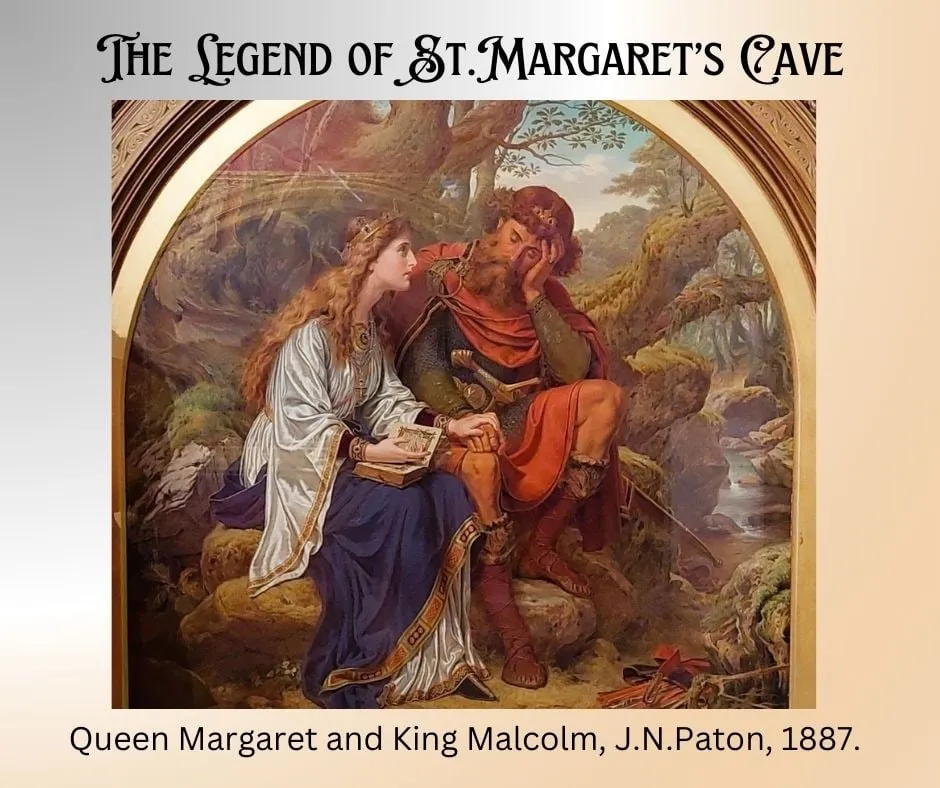
When the Norman conquest destroyed the Saxon line of kings, the Royal family, consisting of Agatha, the wife of Edward the Exile, and her children—Edgar, Margaret, and Christina—took to flight. They intended to seek refuge in Hungary, Agatha’s homeland, but a storm drove their ships into the Firth of Forth. King Malcolm, learning of their plight, was happy to offer them hospitality. He had known the family when he had lived as a refugee from Macbeth at the court of Edward the Confessor. He was now over forty, and Margaret was twenty-four when he spoke of marriage.
She was not in favor of the idea at first. Her intention had been, upon reaching Hungary, to enter a nunnery, for she was of a very devout disposition. However, her mother and her brother Edgar persuaded her to accept Malcolm’s proposal. As the chronicler says, “Queen Margaret was married to King Malcolm the Third with great solemnity at his village and castle of Dunfermline-in-the-woods, a place so strongly fortified that scarce man nor beast might tread its trackless paths.”
The marriage proved to be a fortunate one for Malcolm and Scotland. Margaret was a beautiful young woman of great piety, but she was accustomed to life at the English court, and she lost no time in introducing some splendor into Malcolm’s life. She increased the number of his attendants and ensured that he was served on gold and silver plates. She disapproved of the rude manner in which Malcolm’s knights left the table after meals, so she introduced the saying ‘grace.’ To persuade the knights to remain for the little ceremony, she sent a cup of wine around the table afterward. This was known as the ‘grace cup’ and later became the “loving cup”, which, for centuries, was passed around Scottish tables.
Margaret was brought up by the Benedictines and soon urged her husband to replace the small church of the Culdees with a bigger priory to be built outside the town walls. It was to be known as the Church of the Holy Trinity and would serve as a place of royal burial in the years to come. Margaret made many gifts to the abbey, including jewels of great value, vessels of gold and silver curiously wrought, and a Black Cross, full of diamonds, which she had brought out of England. According to Turgot, the Queen’s confessor and biographer, she performed many devout acts. “Every morning during Lent, she prepared food for nine little children, all indigent orphans. With her own hand, she ministered at the table to crowds of poor persons and washed the feet of six children every evening. Before the time of public mass, she heard five or six private masses. After that service, she fed twenty-four persons, and not till then did she retire to a scanty ascetic meal.”
The Queen gave birth to six sons and two daughters during the twenty-five years of her married life, so that the Tower above the glen must have been filled to overflowing before some of them departed to set up establishments of their own.
Margaret’s contributions to Dunfermline were profound. The Priory and Monastery she founded, was expanded into the Abbey by her son, David I. It became one of the most significant religious and cultural centers in Scotland. Over the centuries, Dunfermline Abbey grew in wealth and importance, attracting many royal burials, including that of Malcolm himself. Margaret’s influence also extended to education and religious reforms, as she sought to bring Scottish religious practices in line with those of the wider European Church. Her efforts laid the foundation for Dunfermline’s enduring status as a center of pilgrimage and devotion, drawing both royalty and commoners alike.
In the end, Malcolm and Margaret met with tragedy. He was killed along with his eldest son, Edward, at the Battle of Alnwick. Margaret, lying ill in the Castle of Edinburgh, did not survive the shock when she was brought the news. Later, fearing that their uncle Donal Bain, a rival claimant to the crown, might desecrate their mother’s body, her younger sons secretly removed her corpse from the castle. The thick mist that descended to shield them on their passage through the ranks of Donal Bain’s besieging army came to be regarded as the first miracle connected to Queen Margaret’s name. Her canonization as a saint took place in 1250, and five years later, in the presence of Alexander the Third and the Queen his mother, “they most devoutly lifted the bones and remains of the renowned Queen Margaret, their ancestor.”
As the procession of priests and abbots who carried the precious load on their shoulders moved across the church toward the new shrine in the choir, their burden suddenly became too heavy for them to carry, and they had to put it down, amidst general consternation. It was noticed that the procession had come to a halt beside the tomb of her husband, Malcolm, and presently a voice called out, “The Queen will not stir till equal honors are performed to her husband.” Maybe it was a coincidence, but the cynics did not fail to point out that Malcolm’s tomb stood right in the way of the daily processions and spoiled the fine view of the interior of the new choir. However, as the chronicler reports, after Malcolm’s coffin was exhumed and carried to a more suitable site in the Lady Aisle, the procession carrying Queen Margaret’s remains was able to proceed without further trouble. They moved to the sounds of the organ and the melodious songs of the choir singing in parts.
This is the first mention of an organ in St. Margaret’s shrine—an oaken cabinet that contained a silver chest, adorned with gold and precious stones, that held the relics of St. Margaret, including her skull, to which her long auburn hair was still attached, together with other bones. On festival days, these relics were displayed to the pilgrims who came to worship at the shrine. All this meant good business for Dunfermline and the abbey, which constantly grew in wealth and importance. After Edward the First had caused the monastery to be destroyed at the beginning of the fourteenth century, the Benedictines decided to rebuild on a more ambitious scale, adding a magnificent guesthouse capable of accommodating the many royal and important pilgrims who came, even in times of war, to worship at St. Margaret’s shrine.
ℹ️This image is an AI-generated representation based on a description of a historical figure.