Historic Dunfermline
The Founding of the Great Church at Dunfermline
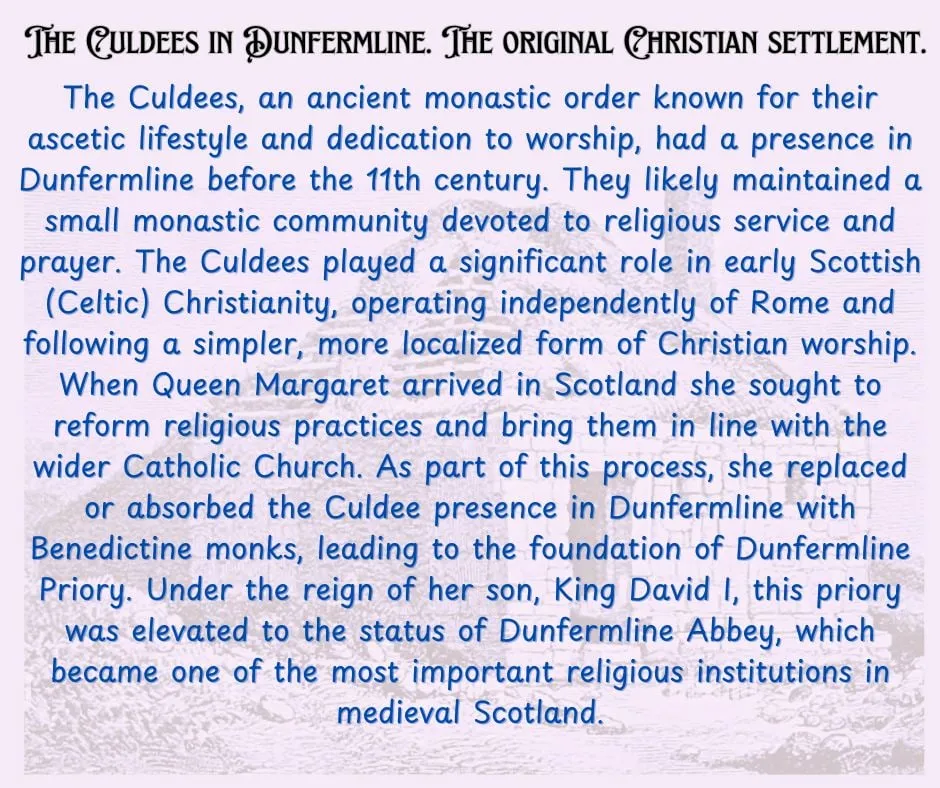
The exact year of the founding of the great Church at Dunfermline is not recorded, but it is presumed to have been shortly after the royal nuptial ceremony of Malcolm III and Queen Margaret. The influx of English nobility and others into Scotland following the arrival of the royal exiles significantly increased the population of the small hamlet of Dunfermline. This growth likely rendered the old Culdean Church unsuitable for the expanding number of worshippers.
Historical accounts suggest that Queen Margaret and her confessor, Turgot, discussed the need for a more suitable place of worship. When the matter was presented to King Malcolm, he not only agreed to build a new church but also envisioned an edifice that would surpass all other ecclesiastical buildings in Scotland at the time. Queen Margaret enriched Dunfermline Abbey with valuable jewels, along with gold and silver vessels, and a Black Cross adorned with diamonds, which she had brought from England.
According to several historical sources, the construction of abbeys and grand churches typically began at the eastern end. As resources allowed, building operations progressed westward, often taking decades to complete. Dunfermline Church followed this tradition, with its construction spanning nearly forty years. The eastern section was likely completed around 1075, three years after the presumed founding date of 1072. During this period, a temporary wall would have been erected to enclose the finished portion for immediate use, while the western section was gradually built.
The foundation of Dunfermline Monastery has long been attributed to King Malcolm III toward the end of the 11th century. This belief is supported by King David I’s confirmation of his father’s grants, as recorded in the Chartulary. Whether the monastery was originally Culdean or Benedictine remains uncertain. However, the dedication to the Holy Trinity aligns with Culdean tradition, contrasting with the Roman custom of dedicating churches to the Virgin Mary or other saints. The transformation of Dunfermline Church into a Benedictine Abbey happened a bit later, although Malcolm III did not live to see its completion. King Alexander I, known as “the Fierce,” is credited with finishing the construction.
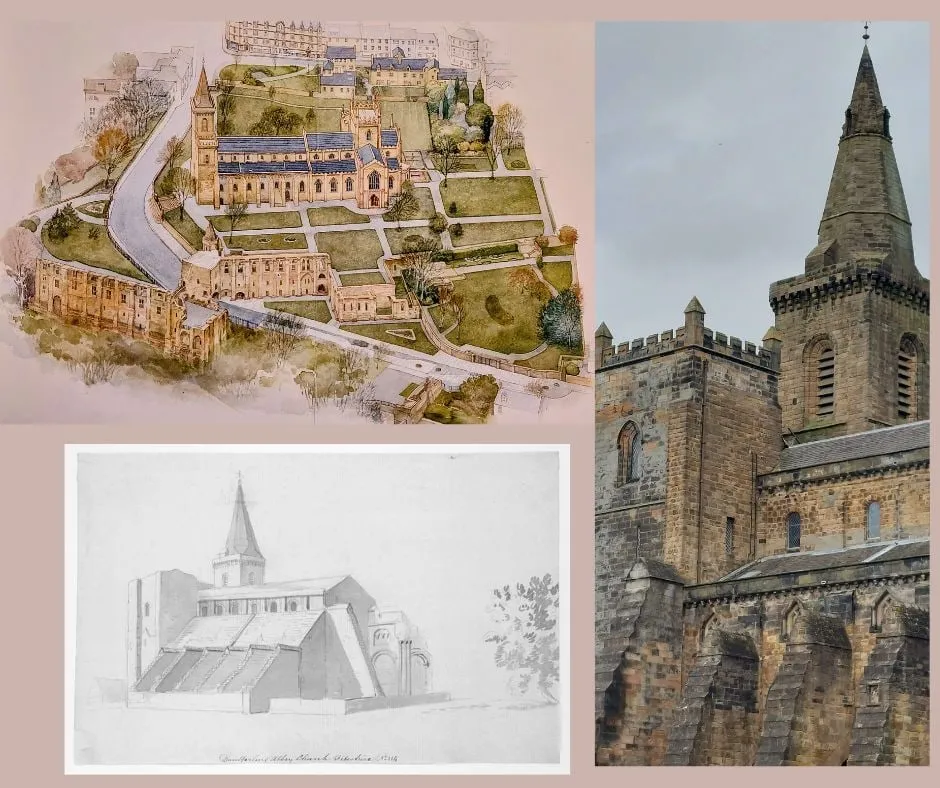
Images from Dunfermline Abbey and Palace guidebook and National Library of Scotland.