Historic Dunfermline
Was Andrew Carnegie actually born on Moodie Street?
Introduction.
The aim of this research is to address the controversy surrounding Andrew Carnegie’s place of birth.
His birth record states that at the time of his birth his family resided on Reform Street, not Moodie Street, as he claimed in his autobiography. This documented fact has never been mentioned in any Carnegie-related sources. This somewhat strange omission stirred my curiosity and desire to uncover the truth.
What you are going to read below is not based on previously published research, as none existed. Understanding the sensitivity of the subject, I carefully collected the information by studying multiple biographies of Andrew Carnegie, his autobiography, books, works and articles written by him. I thoroughly selected and compared descriptions of his life in Dunfermline, as well as his own words about his family and his hometown.
I realised that the information I was seeking was not on the surface. It had to be uncovered from contemporary to Carnegie sources, local accounts, newspaper articles, and the correspondence that was not meant for the public eye. It was all gathered piece by piece.
I went through dozens of genealogical records: births, marriages, census returns, valuation rolls, sasine title deeds for properties on Moodie Street, various maps of Dunfermline and records from Ancestry.com. I paid numerous visits to the Local Studies Department at Dunfermline Carnegie Library, spoke with local historians and studied cumulative accounts such as Anent Dunfermline by Daniel Thomson and When We Were Boys by Robert Syme Mackie.
Here I am sharing my findings from the past two years of research. Of course, it is not possible to fit every single detail of this journey into a blog article; however, I do hope to give you a good overview.
I would like to thank Andrew Carnegie Birthplace Museum for providing access to the museum’s library. Special thanks go to local historian Sheila Pitcairn for preserving her invaluable collection of documented research on the Carnegies and Morrisons and donating it to the Local Studies Department of Dunfermline Carnegie Library. It was there that I discovered personal correspondence related to my research.
The beginnings.
It all started with a simple question that sparked my curiosity. When I studied the life of Andrew Carnegie, I wanted to find out more about what his life was like in Dunfermline before the family moved to America in 1848. The research was inspired by the lack of detailed information and a set timeline about the family’s whereabouts in Dunfermline.
Although the general storyline was well known, including the famous episodes from his childhood, many biographers relied on Andrew Carnegie’s autobiography, sometimes repeating factually contradictory information.
My aim was to restore the timeline of the Carnegies in Dunfermline and fill in the factual gaps where information was scarce or absent.
So, how do you start studying a person? - By accessing their birth record.
Luckily, most of the civil records are now digitised and available to the public at scotlandspeople.gov.uk. You can imagine my surprise when I discovered that the birth record contained the name of a different street, not Moodie Street or any street in its immediate proximity. What surprised me even more was that no one – literally no one – of the biographers had ever mentioned this fact or anything related to it. How was it even possible not to mention or question this information when writing about a person’s life? It was not as easy as now to access the records, but still very possible. Was it done intentionally? After going through almost all existing biographies, it started to seem that this street name was omitted on purpose.
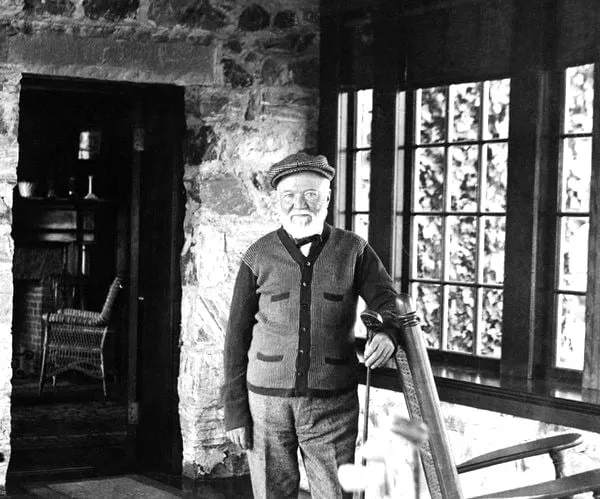
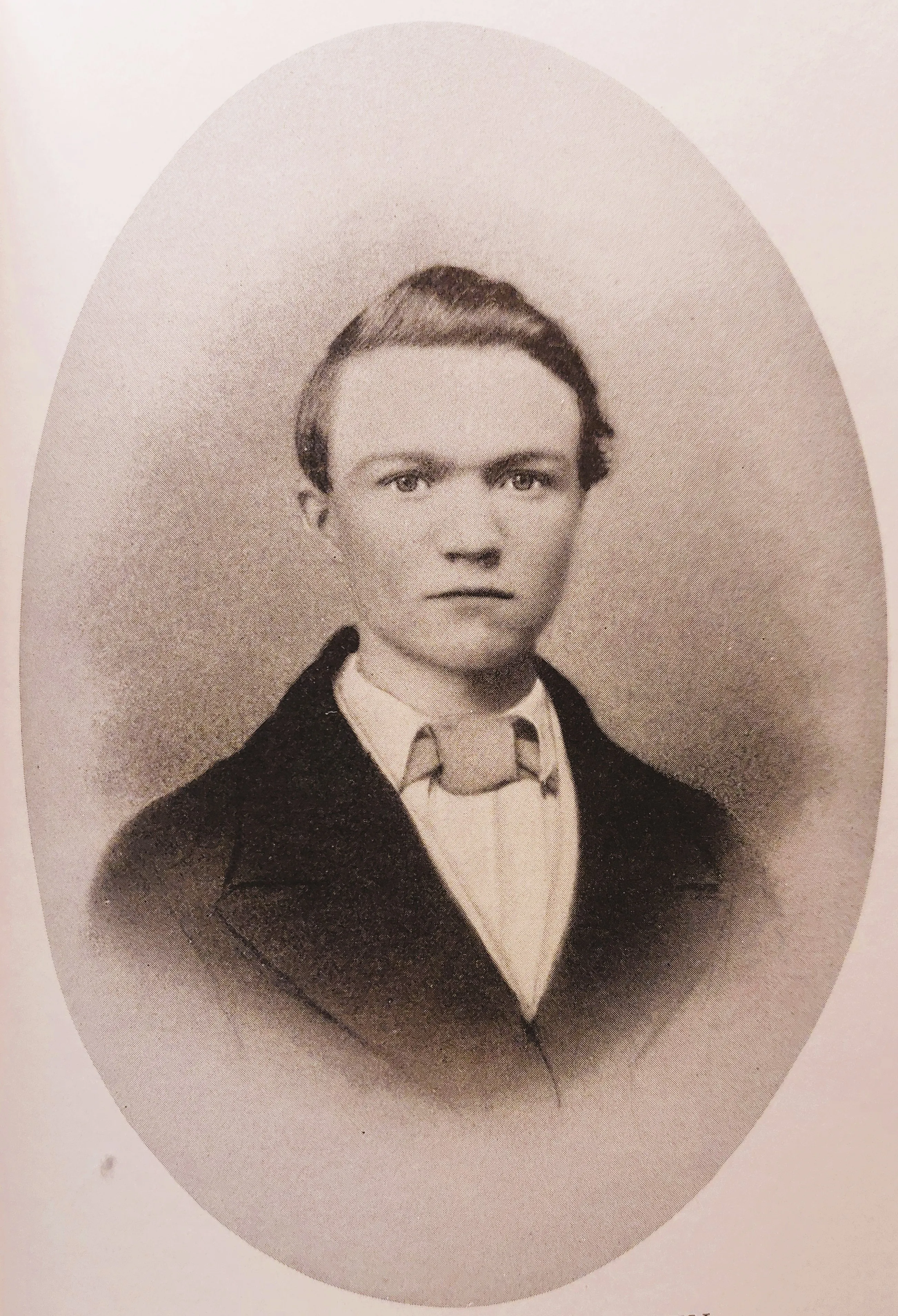 Andrew Carnegie at 16 years old. The image from "The Life of Andrew Carnegie" by Burton J Hendrick, 1932.
Andrew Carnegie’s birth record.
Andrew Carnegie was born on 25 November 1835 on Reform Street. The entry was made in the Dunfermline Parish Register in 1837.
“William Carnegie Weaver Reform Street and Margaret Morrison his Wife had a Son born the 25th November 1835. Baptized and named Andrew. Witnesses Thomas Morrison Senior and Junior”.
Communication with advisers at ScotlandsPeople confirmed that the Reform Street entry named the place of residence of the father at the time of birth. It was an original birth record, entered two years after the birth, in 1837, which was common for the time.
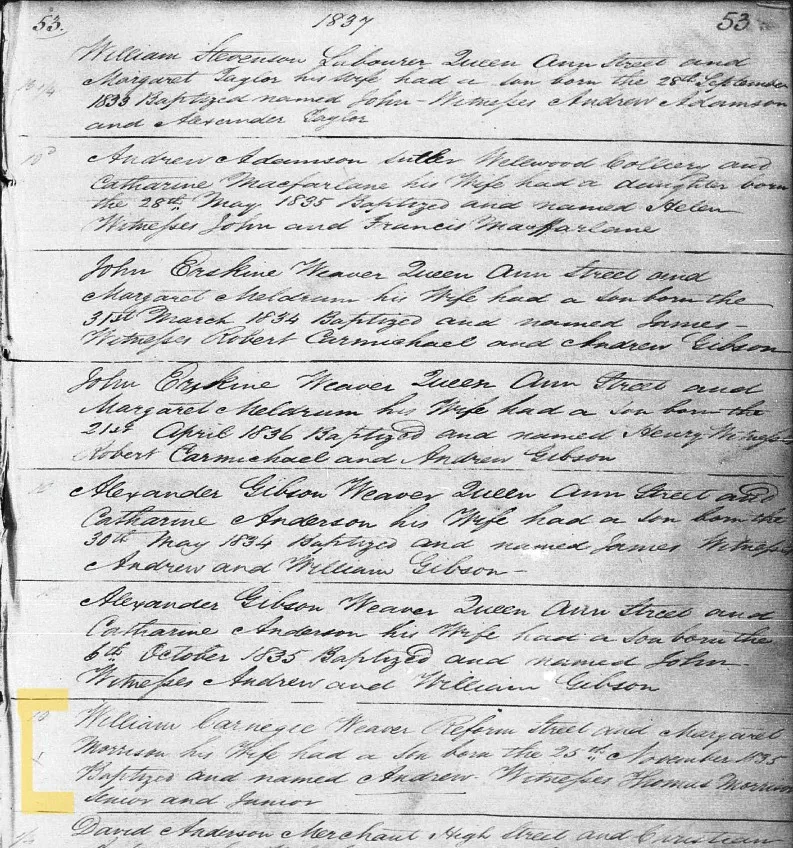 Copy of the image of Andrew Carnegie's birth record. Source: scotlandspeople.org.uk.
So, let’s investigate this Reform Street.
People researching their genealogy, such as Keith Morgan (a descendant of Andrew Carnegie’s great-uncle William Carnegie), had stumbled upon this entry and referred to it in his work. The local researcher Sheila Pitcairn, in her book The Historic Ancestry of Andrew Carnegie, made the assumption that Andrew Carnegie had been baptised in a small church on Reform Street.
However, upon studying local accounts of old Dunfermline by Peter Chalmers and Ebenezer Henderson, and researching Ordnance Survey maps, I did not encounter any mention of a religious establishment on Reform Street. The history of Reform Street does not take us very far into the past. The map of Dunfermline completed by John Wood in 1823 indicates this street as a proposed one. It was established in 1832 after the Parliamentary Reform Act, which granted voting rights to more than 400 citizens of Dunfermline.
In the 1970s, Reform Street was incorporated into Carnegie Drive as part of Dunfermline’s Northern Link Road redevelopment.
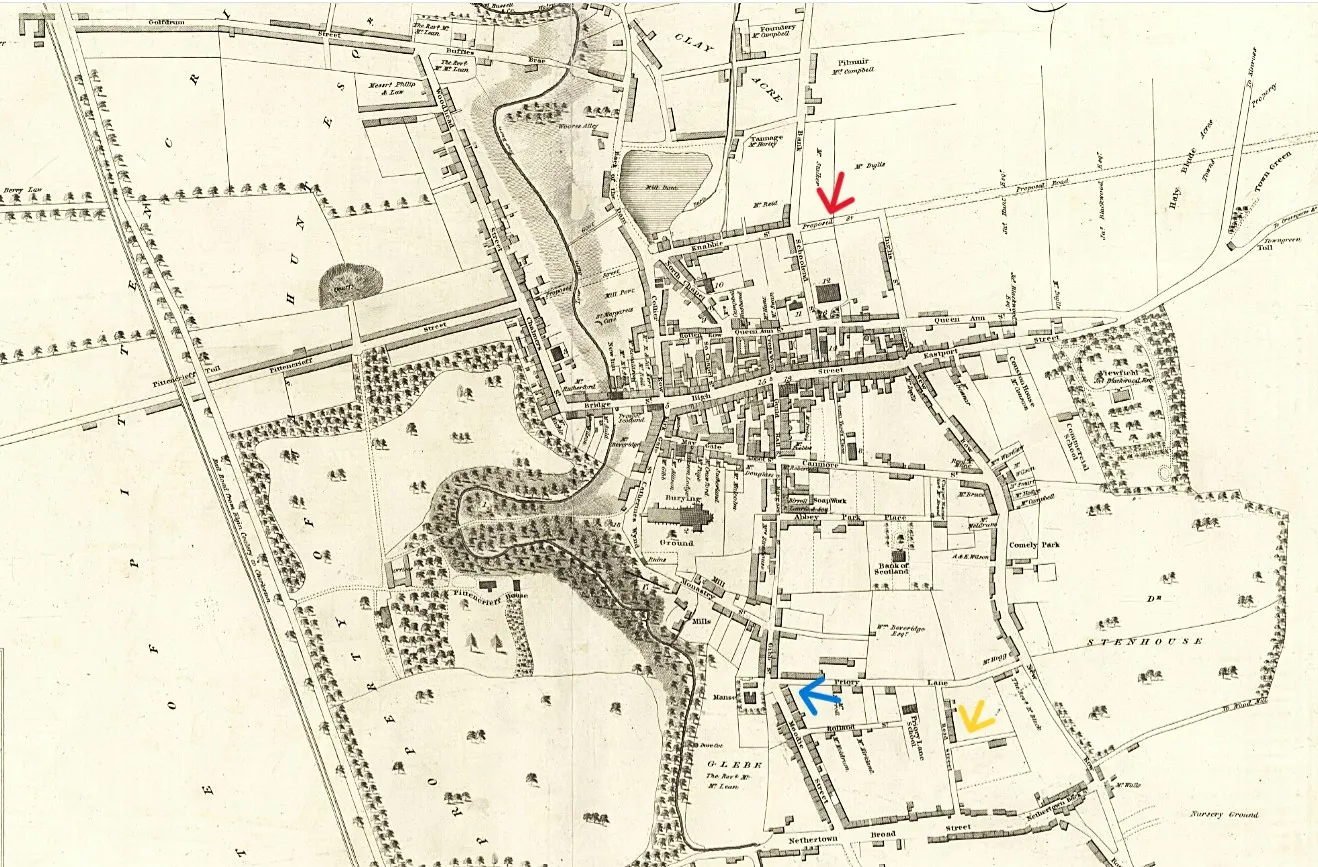 Places of the Carnegies' residences in Dunfermline: blue arrow - Moodie Street, red - Reform Street (here still marked as Proposed Street), yellow - Edgar Street. John Wood, 1823. Source: National Library of Scotland.
Before I go any further, I will reveal that I did find another confirmation of the Carnegies living on Reform Street: the witness account of a man who was a play-nurse (dry-nurse) to Andrew when he was a boy. His account was published in The Sketch in 1901 and was also mentioned by Daniel Thomson in Anent Dunfermline.
Here’s an extract from the article in The Sketch:
“A True Anecdote of Mr. Carnegie’s Childhood.
An old Dunfermline gentleman, now seventy years of age, remembers acting as a kind of dry-nurse and playmate to the child, Andrew Carnegie, while his parents lived in Reform Street. One of the town letter-carriers then lodged with Mrs Carnegie, and, as they frequently received money charged on letters under franked, or not franked at all, they carried a small bag or purse in which to put the cash received. The lad of seven or eight years of age had been sent to rock the cradle of the future millionaire and to divert him. The old gentleman has a clear recollection of taking the letter-carrier’s bag, emptying out the coppers on the seat of a chair, piling these one coin on top of the other, and then allowing little Andrew Carnegie to take one of his father’s wooden spools and knock down the castle of coppers. The little fellow laughed gleefully as the coppers were scattered. Mr Carnegie has scattered a good deal of coin since then.
Reform Street was, doubtless, quite a good street for a young reformer to be cradled in. “Reform” was then in the air. Lecturers such as Thomas Cooper, author of the “The Purgatory of Suicides”, and less known men, harangued the weavers on free suffrage and the points of the Charter. Silk flags were purchased by the weavers, painted by a native artist, and emblazoned by them with emblems and mottoes, while Mrs. Carnegie and her sister, Mrs. George Lauder, adorned the same with hand-flowering in harmonious colours.”
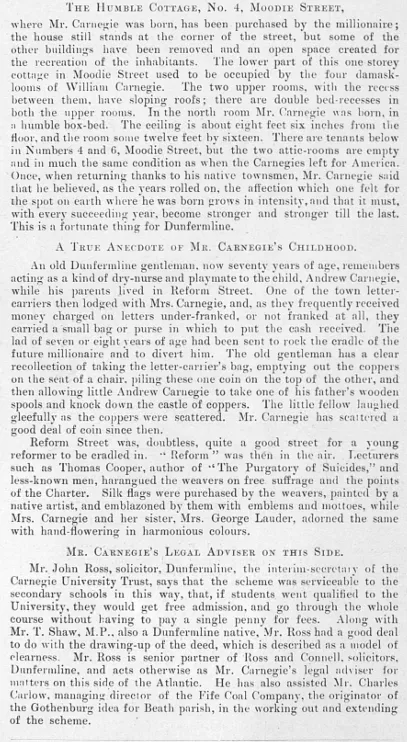 An extract from The Sketch article, 10th of July, 1901.
What do we know from official sources: Andrew Carnegie’s autobiography and numerous biographies?
Andrew Carnegie’s autobiography, published in 1920, has been used as a primary source and has formed the foundation for his subsequent biographies. His biographers scrutinised his life as an industrial tycoon, a great philanthropist and a millionaire who rose “from rags to riches”, yet nobody seems to have questioned the true sequence of his residences in Dunfermline. Instead, Carnegie’s own account was simply and unquestioningly adopted.
His autobiography was published after his death. His wife, Louise, brought all Carnegie’s notes and writings to the editor, John C. Van Dyke, with the request that he compile them into a finished work.
There is an interesting paragraph in the Preface to his autobiography, written by Louise Carnegie:
“Written with his own hand on the fly-leaf of his manuscript are these words: It is probable that material for a small volume might be collected from these memoirs which the public would care to read, and that a private and larger volume might please my relatives and friends. Much I have written from time to time may, I think, wisely be omitted. Whoever arranges these notes should be careful not to burden the public with too much. A man with a heart as well as a head should be chosen.”
Indeed, there are evident omissions in Carnegie’s descriptions of his childhood from his autobiography. We know nothing about the birth and death of his young sister or his interactions with his brother Thomas when they were children. He does not go into detail about his childhood friends.
The main Dunfermline storyline in Andrew Carnegie’s autobiography, as well as in his independent biographies, goes as follows:
Cottage on Moodie Street in 1835 –> Edgar Street (Reid’s Park) two to four years later –> Back to Moodie Street around 1842.
Andrew Carnegie admitted in his autobiography that his earliest memory recollections were from the house on Edgar Street, when he was two or three years old. He remembered his uncle William Morrison and his aunt Annie Morrison talking about going to America. (Note: William Morrison emigrated to America at the beginning of 1838, Catherine Morrison Hogan in the spring of 1838, and Annie Morrison Aitken in May 1840, according to the recollections of Catherine Hogan’s granddaughter, from the Morrisons’ collection donated by S. Pitcairn to Dunfermline Carnegie Library.)
The first official detailed census, taken on 7 June 1841, recorded Andrew Carnegie residing on High Street with George Lauder’s family. His parents - William and Margaret, and his young sister Ann were recorded on Edgar Street. William Carnegie’s occupation was recorded as a cotton weaver, not a linen weaver, as stated in the books. He may, of course, have been skilled in both trades, but this discrepancy is worth noting as it helps build a more complete picture.
After their residence on Edgar Street, the family moved to Moodie Street. According to Andrew Carnegie, his mother opened a shop on Moodie Street when they had sold the looms and moved back there.
David Nasaw, in his biography of Carnegie, described the shop as being part of the family home.
Has anyone ever considered why nothing was ever mentioned in any biographies about the particular place on Moodie Street to which the Carnegie family allegedly moved after having a hard time on Edgar Street?
The information about Andrew Carnegie having been born in the cottage on Moodie Street came primarily from Carnegie himself, when he travelled to Dunfermline as a wealthy man around the late 1870-s. According to witness accounts and newspaper articles, he told people that the cottage on Moodie Street was the place where he had been born.
Or, if we think about it, the boy who spent all his lively years in Dunfermline between the ages of eight and twelve on Moodie Street (starting from 1842, according to the sources), with lots of friends, mischievous ideas, schooling and fun, why would he, in his later years, speak publicly only about the birthplace cottage where he was born, which he did not even remember, according to his own autobiography?
So why would he not cherish the memories of another house on Moodie Street, where his mother had a shop and a garden, where his brother was possibly born, and where he kept his pet rabbits and pigeons? Where he witnessed the hardship and struggles of his parents?
Andrew Carnegie spoke so much during his later visits to Dunfermline about what it was like growing up on Moodie Street (according to newspaper articles), but he never said anything about the actual place where he had spent about four years before moving to America.
The Templemans and the Strachans:
Andrew Carnegie’s family could not have resided in the cottage on Moodie Street before 1838.
Below are transcripts of two private letters between Mary Templeman, one of the daughters of William Templeman, the linen manufacturer who owned the birthplace cottage from approximately 1841, and her niece Annie Birrell Templeman and nephew Ward Birrell Templeman, the children of Mary’s brother Robert, who were residing in America at the time.
The first letter dates from 1910 and the second from 1924. I realise that these dates take us further away from the original events, meaning that recollections could have become mixed up, forgotten or unclear. The information in each letter has, however, been verified by the family records by comparing the dates and checking the timeline of events.
Before William Templeman took ownership of the cottage, the Strachan family lived there. William married their daughter Margaret and became a property owner after his father-in-law, William Strachan, died.
The copies of the letters are part of the Carnegie collection donated to Dunfermline Carnegie Library by S. Pitcairn and can be accessed by the public. The letters were all handwritten and covered mostly family affairs, so I have transcribed only the content relevant to the research and inserted my notes under Historic Dunfermline - HD. The original spelling and punctuation are retained.
Letter 1
402 Byres Road,
Hillhead, Glasgow, 1910
My Dear Niece Annie
In regards to Carnegie home. It belonged to my Grandmother Catherine Black (HD: born in 1778, died in 1843) and she married William Strachan (HD: born in 1774, died in 1838), my Grandfather, and they had 13 children and My Mother was the eldest. (HD: I only managed to find eleven, all born in Dunfermline on Moodie Street, according to their birth entries.) She was born in 1796 - and married 16th July 1819 (HD: Margaret Strachan married William Templeman).
When Grandfather died (HD: 1838, according to his death record) and Grandmother was old and left all alone by herself, my Father bought her home, then he let it out and Carnegie parents lived in the little room on the roof - they were very poor but respectable.
So in 1894 Carnegie bought the…
(Note: Here the letter finishes abruptly. The remainder tells us about Mary sending old spoons to her relatives overseas.)
The Dunfermline Directory of 1835 listed William Strachan, Vintner, at the address 4 Moodie Street.
The 1841 census shows that Catherine Strachan, Jane Strachan and her daughter, together with William Arnott, a baby grandson, were staying in the cottage on Moodie Street at the time.
According to this private letter, the Carnegies only moved in after the head of the family, William Strachan, died, which happened in 1838.
So according to this, Andrew Carnegie could not have been born in the cottage before 1838.
Letter 2
Glasgow. April 8th, 1924.
My Dear Nephew Ward
In regards the Boyhood of your father.., your fathers home was .. mile from the Birthplace of Carnegie. The home that Carnegie was born in was stone built. The low flat had four apartments and two above - the room he was born in was very small (not a loft) - the Carnegie family were very respectable but very poor. Our family knew nothing about the Carnegie family at all till Andrew Carnegie paid his first visit from America to Dunfermline. (HD: This is very important information. She repeats information provided by Carnegie without having any factual memory of it.)
The little house belonged to my Grandmother. (My Mothers Mother), it was built in 1700, and when Grandmother died (HD: in 1843), my father bought it and added a block to it for his work. When Mr A Carnegie saw the room that he was born in. He rented it. Paid 40 shillings per year, so he was my tenant for a short time. About 1894 Mr A Carnegie wanted to buy the whole block, so an agent bought it for him as he didn’t want his name known. (HD: All the records of the ownership are under John Ross, the family solicitor and first Chairman of Dunfermline Carnegie Trust.)
Well, it was sold to him too cheap (except the little corner), he had the whole building knocked down and made into a park for old people to sit in. He kept a caretaker to look after his room and show it to all the Americans who went to see where he was born. I have seen the outside of the house but not the inside. He spent lots of money in Dunfermline, he wanted to put a window in the Abbey but was not allowed. I hope you will understand all I have written about Carnegie - I could tell you more but not able to write it all.
Note: That is all regarding the Carnegies. The letter continues with personal information for the family.
As Mary Templeman said, her family had known nothing about the Carnegies before Andrew returned as a very wealthy man and told them that he had been born there.
The second letter also states that the cottage was passed to Templeman after the death of his grandmother, which happened in 1843. Chronologically, it matches the time when the Carnegies moved back to Moodie Street from Edgar Street.
Did you know?
What made me approach this research with caution was the discrepancy between the year of birth (1835) and the year of registration (1837).
Then I came across a fascinating pattern.
Did you know that Andrew Carnegie, up until the beginning of the 20th century, believed that he was born in 1837?
I came across newspaper interviews in which he said he was eleven years old when he travelled to America. The passenger lists from the ships he travelled on when going to Britain and back to America recorded him as having been born in 1837. In his first American passport application, he was recorded as being 24 years old, although this was later corrected to 26.
This extract from his obituary in the New York Times helps to shed some light.
August 12, 1919
OBITUARY
Carnegie Started as a Bobbin Boy
By THE NEW YORK TIMES
“Until he was a septuagenarian, Andrew Carnegie believed that he was born in 1837. Then on a return visit to his native town in Scotland he learned that the date 1837 in the church records merely meant that the records were commenced in that year, and he was listed as a living child in the first census. He announced his correction of the date of his birth by clicking the news to his brother telegraphers on a miniature telegraph instrument at his plate at the dinner they were giving in his honor, supposing it to be his seventy-first when it was really his seventy-third birthday”.
This confirms that Andrew Carnegie’s birth record as well as the census record were available to him. He was aware that Reform Street had been recorded as his place of birth, but nevertheless, it was completely omitted from his autobiography. This also confirms that this birth record from 1837 was his only birth record.
So, how does one not know how old they are, yet insist on remembering where they were born?
Why might Carnegie have claimed the house he grew up in as his birthplace?
Have you ever noticed that when we speak of Andrew Carnegie’s childhood - his fascination with rabbits, his schooling, trips to the well, and his longing for free access to the Glen - we instantly imagine him in the cottage on Moodie Street?
This is strange, considering that according to his autobiography, he was only born there and stayed for a short while as a baby.
So, let’s look at the reasons why Carnegie claimed the Moodie Street cottage as his birthplace.
Of course, we can assume that some part of his autobiography, in which he honestly declared that he lived with his parents on Reform Street, was missing and never made it into print. Remember that second volume of his autobiography that was made for the family? However, there are other, perhaps more probable, reasons for such a move.
The appeal of humble beginnings.
During the Gilded Age, industrialists faced fierce criticism over monopolies, harsh labour conditions and extreme inequalities, such as those exposed by the 1892 Homestead Strike. Claiming to have been born in a cramped, one-room attic cottage served as an ideological shield, allowing Carnegie to argue that his wealth had been earned purely through grit and merit, and that any poor boy could achieve the same.
No birth certification before 1855.
Statutory civil registration did not begin in Scotland until 1855, twenty years after Carnegie was born. In the late 19th century, proving an exact street address for a birth in 1835 was virtually impossible unless a rare private diary had survived. In our case, however, there was a birth record.
Establishing historical consensus.
Once Carnegie became one of the richest men in the world, his word, backed by his massive philanthropy and his 1920 autobiography, effectively became the official historical record. Local townspeople and biographers had every financial and civic incentive to agree with him rather than challenge their greatest benefactor.
Need for a tangible monument.
Great men in the Victorian era expected their birthplaces to become public shrines. It is a well-known fact that the Moodie Street cottage had a visitors’ book, serving as proof that people from all over the world were eager to come and see the birthplace of the famous philanthropist. Mary Templeman mentioned in her letter that lots of Americans came to see the place where Carnegie was born.
If his actual birthplace had disappeared or held little personal significance, the surviving cottage offered a tangible and more picturesque link to his past, and perhaps an emotional connection.
From the personal correspondence of Mary Templeman, we know that Carnegie actually stayed for some time in the attic room of the cottage during one of his visits (likely unannounced) to Dunfermline in the early 1890s. Why would he bother if he had merely been born there and had no actual memories of living there? Unless he did have an emotional connection to the place because it was where he grew up.
Anchoring his philanthropy.
By declaring the Moodie Street cottage his birthplace, and having his wife purchase it in 1895 (as we now know, the purchase of several Moodie Street houses, numbers 2–10, and the property at the back owned by Gas Works was registered under Carnegie’s solicitor John Ross; however, Louise Carnegie, in her official statement to Dunfermline Carnegie Trust in 1910, did indeed say that she purchased the properties), he created a permanent landmark associated with Carnegie’s legacy in Dunfermline, alongside his many contributions to the town, including Pittencrieff Park, the Public Baths and the first Carnegie Library.
Honouring his parents’ struggle.
Even if he was not born inside the exact room, the cottage represented the peak of his parents’ working-class dignity before steam looms destroyed their livelihood. Claiming it as his birthplace immortalised his father’s craft and his mother’s resilience.
In one of the newspaper articles, I encountered the statement that Andrew Carnegie intended to purchase the cottage to commemorate his mother, her struggles, resilience, immense love and care for her family.
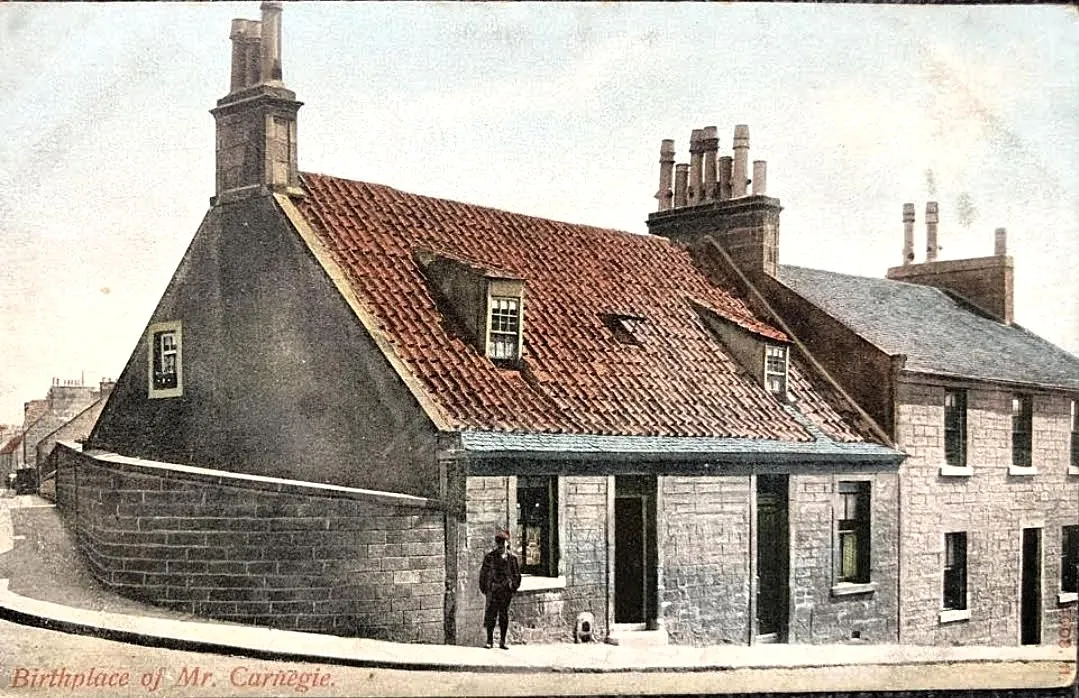
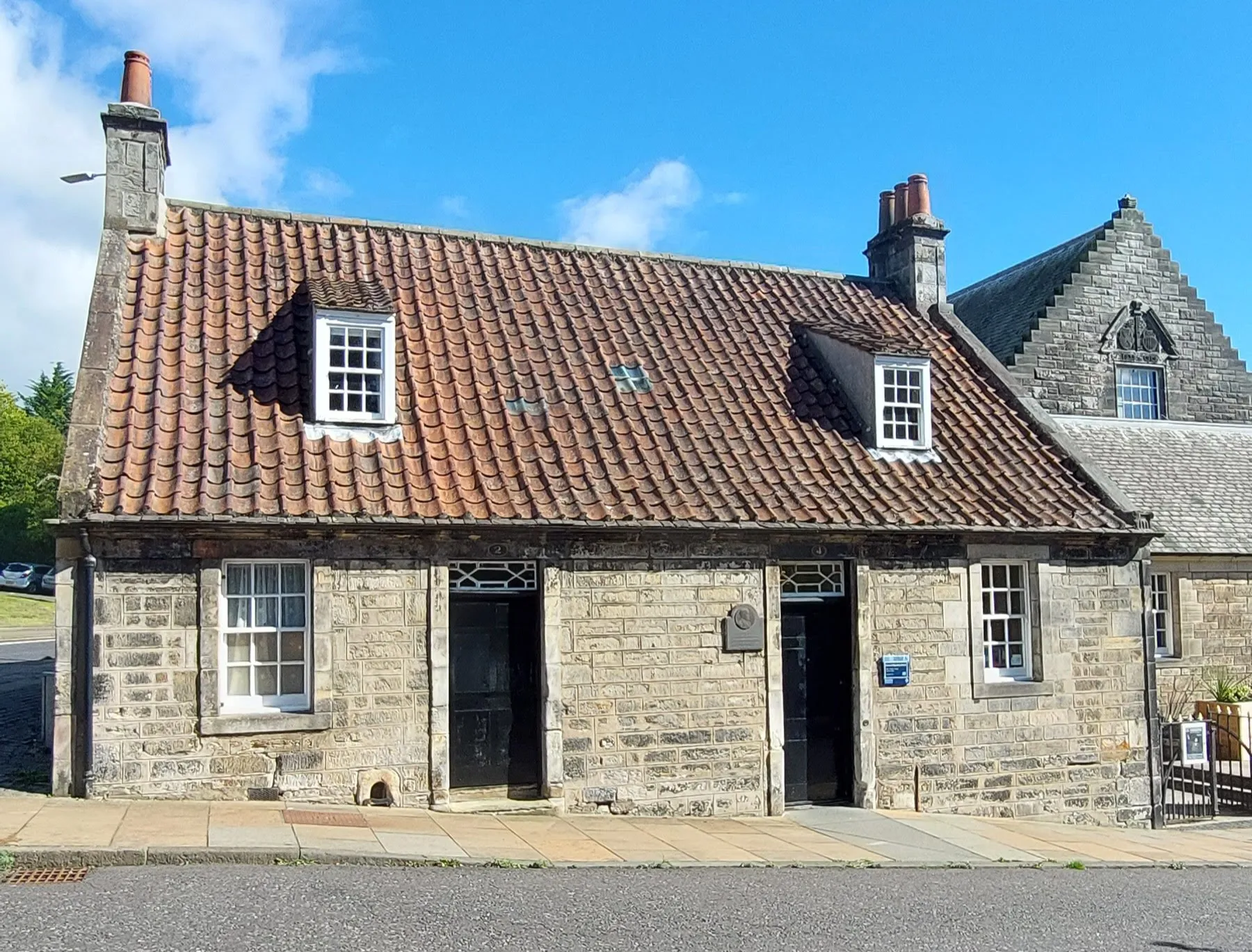 Modern picture of the cottage on Moodie Street - part of Andrew Carnegie Birthplace Museum.
In conclusion
So, where was Andrew Carnegie’s birthplace?
Based on the factual evidence presented, the Carnegies very likely lived in the cottage on Moodie Street. There is also strong evidence suggesting that they could not have occupied the cottage before it changed ownership in the early 1840s.
It is therefore possible that a significant detail in Andrew Carnegie’s biography was overlooked: the family’s earlier residence on Reform Street, where I suggest he was actually born.
I do believe that the cottage on Moodie Street was very dear to him, as he cherished his happiest childhood memories of the place where he grew up. We can look at this metaphorically and speculate that it was there that he was born as a true Dunfermline citizen, a loving and caring son, a true friend and one of the most outstanding sons of Dunfermline.
The main purpose of this research was to discover the truth about something that has been concealed for years. This would have no impact on Carnegie’s legacy in Dunfermline, make his philanthropic contributions to the town any less significant, or devalue the precious historical collection kept at his museum.
Back in the nineteenth century, he created an amazing story of his childhood and placed it within a home where he was raised. He had his own reasons for claiming it as his birthplace, and we will never truly know what stood behind this decision.
History is always full of mysteries. As an explorer of local history, I find myself extremely lucky to have the opportunity to uncover one of them.