Historic Dunfermline
Robert Henryson: Dunfermline’s Remarkable Medieval Poet
Robert Henryson was a prominent Scottish poet who flourished around 1460–1500. He was born around 1437—the year of the death of the poet-king James I—and died close to 1503, the year of the English marriage of James IV, an event that would prove fateful for Scotland.
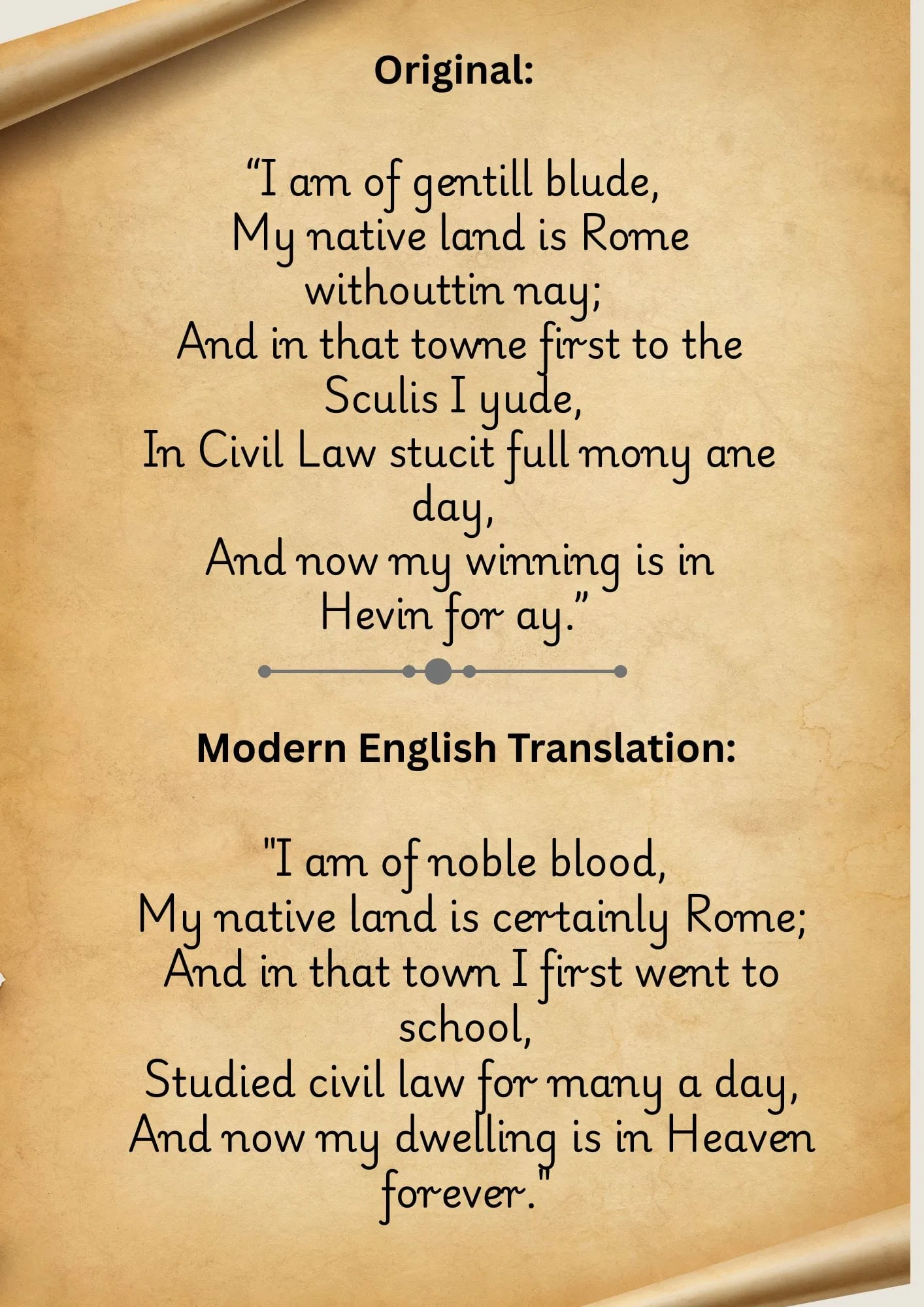
Little is known with certainty about his life, but surviving records suggest he was a teacher with training in both law and the humanities. The earliest record of him appears on 10 September 1462, when a man of his name, licensed to teach, is recorded as taking a post at the newly founded University of Glasgow. It has also been speculated that, before his time in Glasgow, he might have travelled extensively and studied arts and canon law in Paris or possibly Rome.
He is described as having been the chief schoolmaster of Dunfermline, and he was also a notary public, serving at the Abbey Monastery, which was not uncommon at the time for an educated ecclesiastical clerk.
Ecclesiastical and civic roles like those Henryson held were typically given to local citizens, not outsiders. This supports the view that Henryson—and perhaps his family—had deep roots in Dunfermline.
A theory, though now largely dismissed, suggests Henryson may have been the same man as “Robert Henryson of Fordell,” possibly the father of James Henryson, a royal justice who died at Flodden in 1513. This claim seems to have originated with Sir Robert Douglas, who cited a 1478 charter from the abbot of Dunfermline, in which a Robert Henryson appears as a witness. The confusion likely arises from the fact that “Henryson” (or the modernised “Henderson”) was a relatively common surname. While the notary, the schoolmaster, and the landowner may have been two different people, it is plausible that the schoolmaster also served as a notary—a typical arrangement in an era when clerics often fulfilled legal functions. However, the ecclesiastics didn’t usually leave legitimate heirs.
Whatever his exact biography, Henryson was a remarkable and versatile Dunfermline citizen: a monastery schoolmaster, an ecclesiastical clerk, perhaps even a local landholder—and without question, an outstanding and witty poet.
Henryson wrote in Middle Scots at a time when it was the official language of the state and court. His work consists chiefly of narrative poetry, and his surviving corpus includes nearly 5,000 lines.
The greater part of his poetry was composed during the unsettled reign of James III, and it was undoubtedly the troubled Scotland of that era that shaped Henryson’s writing.
He is widely regarded as one of the greatest Scottish poets of the late medieval period and a central figure in the development of Middle Scots literature. His work blends classical sources, medieval scholasticism, and a distinctly Scottish voice, showing both moral depth and psychological insight.
His main works include The Testament of Cresseid, The Moral Fables (also known as The Morall Fabillis of Esope the Phrygian), Orpheus and Eurydice, and several short poems.
Henryson’s poetry consistently conveys moral lessons, often rooted in Christian ethics but delivered with nuance and subtlety. He explores the contradictions of human nature—desire vs. reason, pride vs. humility, idealism vs. reality—and treats justice not as harsh retribution but as something tempered by compassion. This is particularly evident in The Testament of Cresseid, where readers are invited to suspend judgment and consider human frailty.
Reflecting the medieval worldview, he acknowledges the role of fate, often linking it to moral choices or divine will. His fables, in particular, critique social injustice, including the corruption of the clergy, the abuse of power, and the exploitation of the weak by the strong.
Robert Henryson died in Dunfermline at a very old age, succumbing to a “diarrhae or fluxe.” Ebenezer Henderson in Annals of Dunfermline recounts a story in which the elderly poet sought a remedy for his illness from a wise woman using herbal medicine. Unfortunately, it proved ineffective, and he passed away shortly thereafter.
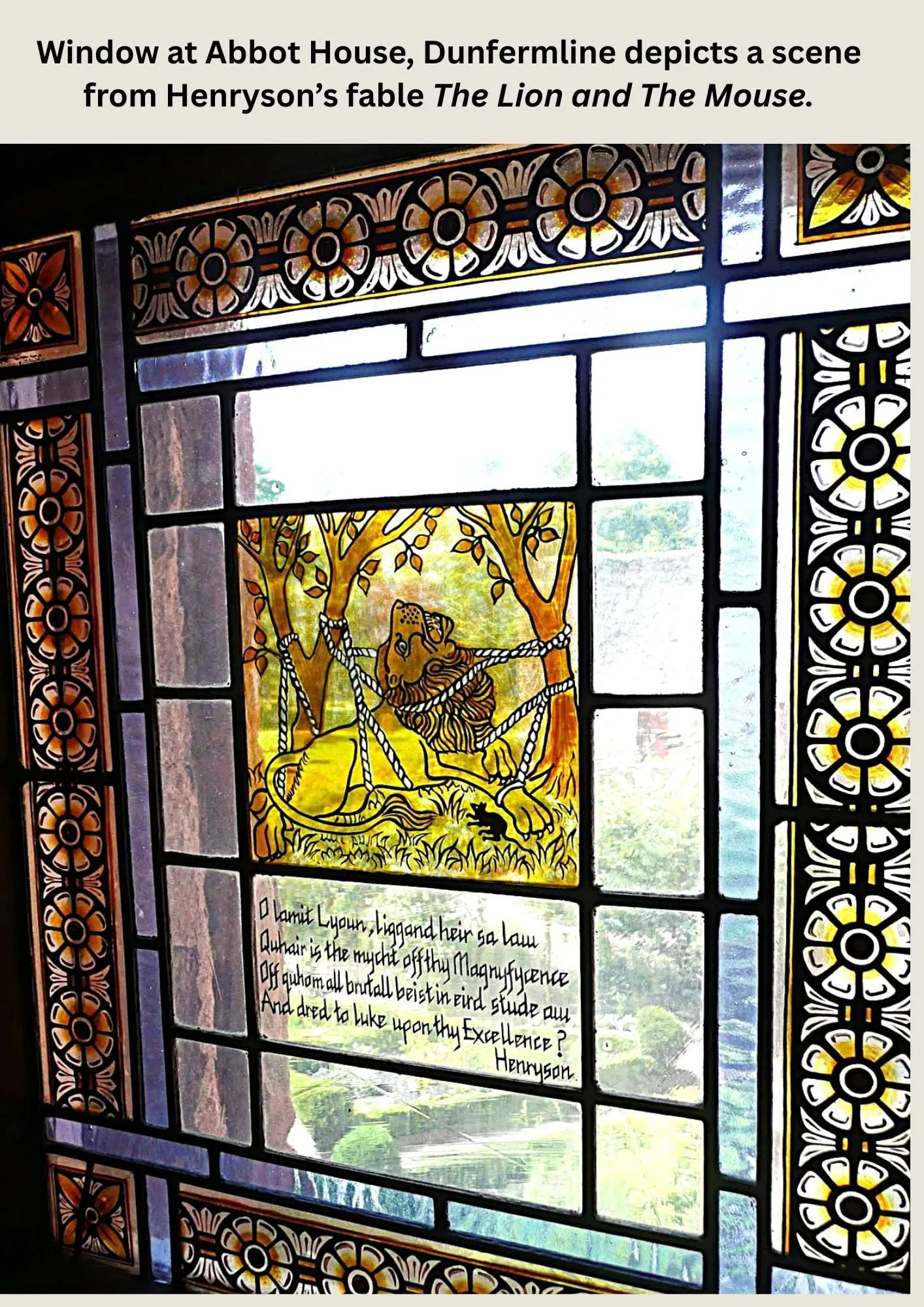
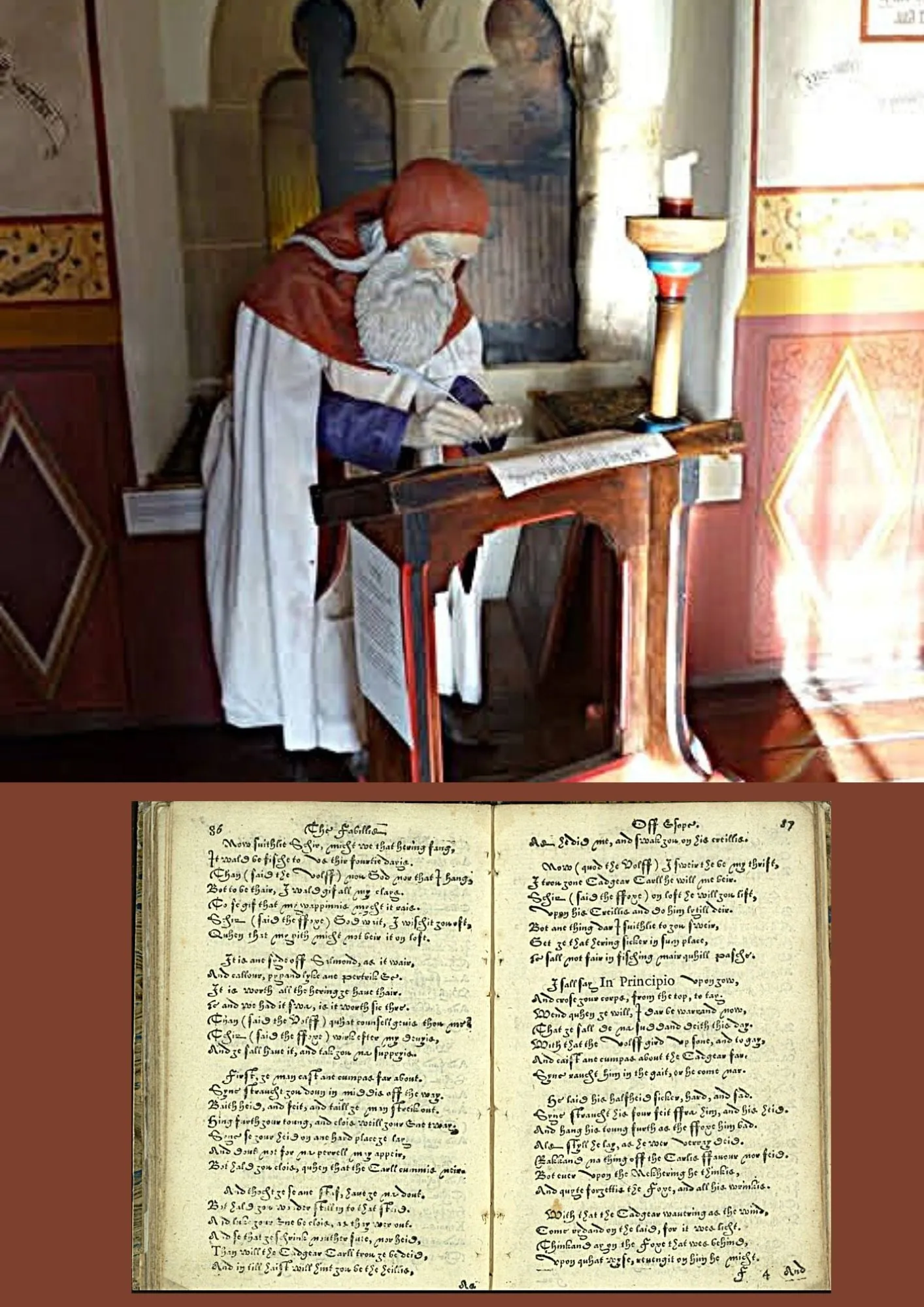
Images: Robert Henryson installation at Abbot House, 2011; original book of the Fables (Moral Fabillis) by Robert Henryson at National Library of Scotland; the citation from the prologue to Moral Fabillis by Robert Henryson; stained glass window at Abbot House, 2011.
Photographs